 Human Security Centre Human Rights and International Security Research
By Sam Biden, Junior Fellow
19 August, 2026
Background
2026 marks three years since the Memorandum of Understanding (MoU), an agreement intended to enlist Tunisian authorities in preventing departures of migrant and asylum-seeker boats bound for Europe, which was signed on 16 July 2023. This anniversary has sparked renewed scrutiny of the arrangements between Tunisia and the EU, with the central criticism being that the MoU has entrenched and legitimized a pattern of serious abuse, with several documented cases resulting in death, serious injury and mistreatment. Consequently, the EU’s continued financial and operational backing of Tunisian migration enforcement cannot be viewed as separate from these violations. To date, €105m has been channeled towards maritime interceptions and border control activities in Tunisia. In the years since the agreement’s signature, a consistent and expanding body of evidence, drawn from UN bodies, human rights organizations and humanitarian groups alike, has documented violent and reckless conduct during sea interceptions, including arbitrary detention, torture, sexualized violence and collective expulsions.
The criticism comes at a crucial time for Tunisia. Thousands of Tunisians gathered in the capital to demand President Kais Saied’s resignation, voicing anger over deteriorating living conditions, sustained democratic backsliding and continued mismanagement of the state that has led to instability. Saied’s opponents have accused him of exploiting emergency powers to systematically reverse Tunisia’s democratic transition and continue to implement draconian practices, such as violence against political opponents, persecuting free speech and implementing dangerous agreements such as the MoU. Wissam Sghaier, spokesman for the opposition Jomhouri party, characterized the protests taking place as an effort to hold the system of governance accountable and expose its failures, framing it as a core responsibility of Tunisia’s political and civil forces rather than an optional act of dissent.
Amnesty International (AI) remains a core organization in the fight against the MoU, repeatedly calling on Tunisian authorities to reverse the problematic policies that have systematically stripped refugees and asylum seekers of protection. Since 2023, Tunisian authorities have subjected refugees and asylum seekers, particularly those who are Black, to a sustained and deliberate policy of racialized exclusion, driven by inflammatory rhetoric from senior officials and enforced through discriminatory arrests, mass detention and the collective expulsion of tens of thousands of people.
The crisis deepened significantly in June 2024, when Tunisian authorities quietly ordered the UN Refugee Agency (UNHCR) to suspend both asylum registration and refugee status determination. This decision was never publicly announced, leaving thousands of already vulnerable people further exposed to violations and abuse. This did not occur in a vacuum, however, but unfolded squarely within the EU’s broader externalization strategy, through which the bloc has continued expanding its support for Tunisian migration enforcement despite mounting evidence of the harm that such support enables. Separately, UN experts have raised serious alarm over the treatment of migrants, refugees and trafficking victims during search and rescue operations. Between January and July 2024 alone, 189 people, including children, are reported to have died during crossings, with a further 265 dying during interception operations and 95 more reported missing, several of whom may constitute victims of enforced disappearance.
Alongside this, allegations of dangerous interception maneuvers, physical violence and the deliberate removal of boat engines and fuel during interceptions demonstrate a cynical pattern of abuse. Survivors have reportedly been subjected to arbitrary transfers towards the Algerian and Libyan borders, denied humanitarian assistance and left exposed to dehydration, malnutrition and injury. Sub-Saharan migrants, refugees and asylum seekers have also been disproportionately and repeatedly subjected to violence at the hands of Tunisian security forces, with experts additionally flagging systemic failures to identify or protect victims of human trafficking. Reports indicate that migrants, especially children and pregnant women, have been transported to desert border regions and fired upon by guards attempting to prevent their return. Despite the scale and consistency of these findings, Tunisia continues to be treated as a legitimate place of safety for the purposes of search and rescue, with cooperation under the MoU proceeding uninterrupted.
Witness Testimony
Since February 2026, AI has gathered direct testimony from 24 asylum seekers and refugees originating from Afghanistan, Algeria, Cameroon, the Central African Republic, Guinea, Libya, Sierra Leone and Sudan. Among them was a man named Valentin, a registered refugee from Cameroon, who was detained in Tunisia’s capital, Tunis, for several months last year after authorities refused to acknowledge his refugee status or grant him access to UNHCR, choosing instead to convict him of illegal entry.
Similarly, several women asylum seekers from Guinea and Sierra Leone remained captive inside the Ouardia Reception and Orientation Centre, a detention facility in the capital, having been arrested for begging. Tunisian authorities have, in practice, repurposed the Ouardia Centre into a facility for indefinite and unlawful administrative detention, despite it originally being intended for lawful detention prior to recognition of immigration status. Beyond individual cases of detention, AI documented a further 12 cases of collective expulsion to the Algerian or Libyan borders since June 2024, each following arbitrary arrest or maritime interception. Among those expelled was a 13-year-old Sierra Leonean boy, seized alongside his family while begging, transported to the Libyan border and handed directly to an armed group, where he was then held for ransom for several weeks. One Guinean asylum seeker described being expelled to Libya alongside more than a dozen other women, subjected to a forced and humiliating strip search at the border before enduring a year of captivity and repeated sexual violence at the hands of an armed group demanding ransom. At the time of writing, 16 of those interviewed by AI had lived, or were still living, on the streets, with twelve facing imminent eviction at the time of the interviews. Several women described being driven into transactional relationships with Tunisian men simply to feed their children, having already been repeatedly arrested and stripped of what little money they had while begging.
Following the suspension of human rights operations and the testimony of those interviewed, safe departure from Tunisia appears to have become almost impossible for those with irregular status. Resettlement opportunities remain scarce, regularization pathways are minimal, and many remain further trapped after authorities confiscate their identity documents upon arrest.
Joint Statement
The relationship between the EU and Tunisia has come under renewed and significant scrutiny, with 46 human rights organizations, notably Human Rights Watch (HRW) and AI, calling on the European Commission and its member states to publicly denounce Tunisia’s human rights record and withdraw funding from its migration enforcement apparatus.
In a joint statement, the organizations describe how the signing of the EU-Tunisia MoU has not simply failed to safeguard the rights of refugees and migrants; rather, it has actively fueled and normalized serious violations while eroding the EU’s own leverage to address Tunisia’s deteriorating human rights record. The statement’s central demands are unambiguous – the European Commission and its member states must immediately suspend border and migration control support to Tunisia. The statement outlines the following formal recommendations:
- Ensure accountability and oversight – A comprehensive review of all EU-Tunisia migration cooperation is required, ensuring compliance with international human rights, refugee and maritime law, and guaranteeing that no further EU funding or material support contributes to, or perpetuates, ongoing violations. This should be paired with full and genuine transparency, requiring the publication of action documents for every EU-funded migration programme operating in Tunisia, alongside their human rights assessments, funding decisions, and both internal and third-party monitoring reports.
- Safeguard international protection – This requires ending all operational, technical and financial support, including indirect support, to the Tunisian National Guard and the Tunisian Maritime Rescue Coordination Centre, both of which remain directly implicated in the abuses documented in this article. Alongside this, the European Commission should publish the criteria and assessments underlying its decisions on whether Article 2 of the Treaty on European Union has, or has not, triggered any suspension, amendment or corrective measure in relation to MoU funding, in line with recommendations already issued by the European Ombudsman and European Court of Auditors in 2024.
- Revoke Tunisia’s safe country status -Tunisia’s designation as a safe country of origin should be revoked outright, reflecting the reality on the ground rather than a legal fiction convenient to migration policy. EU member states must ensure that disembarkation is never instructed to Tunisia, nor should vessels in distress be referred to the Tunisian MRCC under any circumstances. Sustained pressure should likewise be placed on Tunisian authorities to re-establish a functioning refugee protection system and restore UNHCR’s ability to operate without restriction. Public diplomacy at the highest levels should also be used far more consistently to condemn the ongoing crackdown on other human rights violations.
- Uphold rights-based cooperation – Finally, all future cooperation with Tunisia must include strict and enforceable human rights safeguards, rather than the largely symbolic language that has characterized the MoU to date. This means ending the broader practice of outsourcing migration control to third states that fail to uphold human rights and routinely evade meaningful monitoring, while upholding the principle of non-refoulement as a non-negotiable foundation of migration policy.
Conclusion
Three years on from the signing of the EU-Tunisia MoU, the evidence assembled across these findings points not towards an isolated policy failure, but towards a deliberate and sustained pattern of complicity. What was framed as a narrow migration control arrangement has, in practice, immersed into the financial and operational backbone of a system responsible for arbitrary detention, torture, sexualized violence and unlawful collective expulsion. Consequently, the EU’s continued funding of Tunisian security forces, most notably the Coast Guard and National Guard, cannot be separated from the abuses those same forces have repeatedly documented committing.
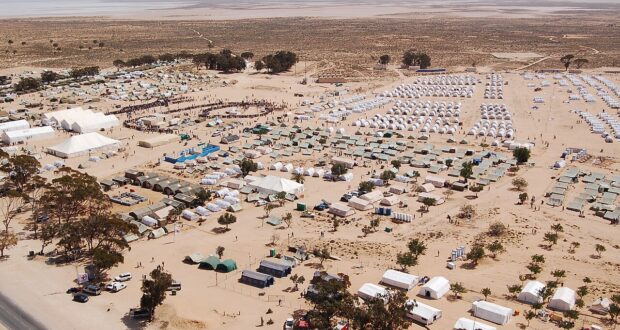
Image: Choucha refugee camp in Tunisia (Source: Major Soussi via CC BY-SA 3.0)