 Human Security Centre Human Rights and International Security Research
By Sam Biden, Junior Fellow
10 June, 2026
In armed conflicts, the role of humanitarian workers (HWs) can never be understated. Acting as the frontline to deploy aid, liaise with communities and evacuate civilians, they serve as one of the core foundational pillars for mitigating crises. However, their presence in conflict zones can be seen as imposing upon the parties to the conflict, especially when they provide aid to what can be seen as the enemy, This has, unfortunately, resulted in HWs being targeted directly as a means of mitigating aid to opposing forces, driving forward political or social statements and causing maximal harm to civilians.
ACAPS Access Indicators
Humanitarian NGO, formerly known as the “Assessment Capacities Project”, now ACAPS, provides detailed analysis of “access indicators”, reflecting constraints and actions taken against HWs, ranked levels 1-5, with 5 being the most severe. Recent assessments indicate that a combination of armed conflict, political obstruction and deliberate targeting of HWs has significantly undermined the delivery of assistance, resulting in 8 states being categorized as level 5 danger to HWs.
In Burkina Faso, humanitarian access remains severely restricted because of persistent insecurity, blockades and the widespread presence of improvised explosive devices (IEDs), causing greater access risk for HWs. Alongside this, key measures imposed by the government, such as mandatory armed escorts for aid convoys, have further complicated operational delivery. Despite the armed escorts, reporting over recent years highlighted a sustained pattern of violence, with hundreds of recorded incidents affecting HWs since 2019. Among the incidents were the deliberate killings of HWs, maiming and kidnapping, with local humanitarian groups being targeted the most. The motivations behind such attacks remain ambiguous, ranging from economic opportunism to suspicions of collaboration with opposing actors and providing aid to enemy forces.
A similarly restrictive environment is evident in Myanmar, where access constraints have intensified following the 2021 military coup. In opposition to Burkina Faso, incidents involving detention and arrest constitute the most prevalent form of targeting within Myanmar, with the military junta responsible for most reported cases. In addition to personnel risks, humanitarian assets have been subject to looting, destruction and occupation for use by the military junta, indicating a pattern of diverting aid away from those most in need, repurposing it for state use. The resulting environment has forced organizations to relocate or suspend activities in key regions, particularly where clashes between state and non-state actors persist, such as Saigaing.
In Palestine, the protracted conflict that initiated post-October 7 includes continually erupting violence against HWs, representing one of the world’s worst humanitarian situations. Israel being credibly accused of blocking aid into Gaza last year, compounded with ongoing and escalating military operations, has resulted in exceptionally high fatality rates among HWs. Humanitarian infrastructure, including healthcare facilities and distribution centers, has been extensively damaged or destroyed by both parties, with Israel systemically targeting them alongside Hamas repurposing them for military use. These conditions have compelled organizations to scale back or suspend operations, severely limiting the availability of essential services to civilian populations.
In Somalia, risks are more associated with non-state armed groups, with them being directly responsible for causing intercommunal conflicts, creating a far more hostile and persistent threat for HWs. Humanitarian efforts are repeatedly disrupted by shootings, kidnappings and intimidation by local groups, causing heightened attention to be placed on collateral harm, rather than direct targeting of HWs. Insecurity surrounding the ground access has also caused logistical issues, dampening the effectiveness of the use of air transport to deliver aid, delaying assistance delivery and causing both more civilian harm and poor public perception of HWs.
The operational environment in South Sudan helps build on the risks faced by HWs at the communal level as seen in Somalia. The country consistently records high levels of violence against HWs, with incidents frequently occurring during transit along insecure road networks. National staff are disproportionately affected, often targeted in the context of intercommunal violence or due to perceived economic status. In neighboring Sudan, the ongoing conflict between the Sudanese Armed Forces and the Rapid Support Forces has generated severe access constraints. The extreme violence against HWs and infrastructure has increased since the outbreak of the Sudanese civil war in 2023, resulting in one of the worst humanitarian crises seen in decades, affecting an estimated 25m people. With deliberate targeting of HWs, collateral damage from explosives contributing to indirect harm, attacks on healthcare facilities alongside the spread of misinformation, security for humanitarian organizations has reached an all-time low in the region, causing repeated statewide suspensions of aid from USAID.
In Ukraine, humanitarian access remains constrained by the continued intensity of hostilities and the widespread presence of explosive hazards, with repeated shelling, missile strikes and drone attacks continuing to pose direct risks to HWs, while contamination from mines and unexploded ordnance limit safe regional access. Most incidents have affected Ukrainian national staff, underscoring a heightened exposure to frontline risks, especially in occupied areas closer to the Ukraine-Russia border, with safe access expected to become scarcer as the conflict persists.
Finally, in Yemen, humanitarian operations are hindered by a combination of insecurity and systematic restrictions imposed by de facto authorities. Described as the worst humanitarian situation of the modern day -a lack of aid, food, water and medical treatment, in combination with arbitrary detentions, harassment and violence has resulted in significantly reduced access, especially in rebel Houthi controlled regions. National staff currently constitute much of the humanitarian workforce, facing disproportionate risks due to their visibility and limited state protection in the war-torn state. The politicization of aid by the Houthi-led coalition, alongside extremist groups such as Al-Qaeda and the Yemeni militant branch of ISIS (IS-YP), alongside economic incentives such as extortion and resource diversion, continues to drive the overwhelming levels of violence against HWs.
Global Trends
While the key data from ACAPS only represents the direst situations, the global picture on the overall state of protection for HWs doesn’t offer much positive discourse either.
Recent global reporting indicates a marked and sustained escalation in violence targeting HWs, reflecting a broader deterioration in the operational environment beyond the direst situations. Trends highlight that between 2015 and 2024, the number of major violent incidents affecting aid workers rose from 157 to 599, representing a near-fourfold increase. Over the same period, the total number of victims increased from 297 to 861, while fatalities more than tripled, reaching 383 in 2024. Kidnappings, long a persistent feature of humanitarian insecurity, also remain elevated, with 125 recorded cases in 2024 alone. High-casualty contexts, such as the Gaza Strip, recorded by far the highest number of victims, followed by countries such as Sudan, South Sudan, Nigeria and Ukraine. The means of attack vary across contexts but are dominated by high-impact methods, including aerial bombardment, shelling and shootings, alongside kidnappings and the use of IEDs.
A defining feature of contemporary humanitarian insecurity, as seen in Yemen, Ukraine and South Sudan, is the disproportionate impact on national staff. In 2024, national HWs accounted for many victims, with 834 affected compared to significantly smaller numbers among international staff. This imbalance is consistent across high-risk contexts such as Myanmar, Burkina Faso, Somalia and Sudan, where local staff – particularly those affiliated with national NGOs or Red Cross and Red Crescent societies – constitute the primary frontline workforce. Their extensive community presence, combined with comparatively limited access to protective resources, places them at significantly greater risk.
The nature of perpetrators also reflects the complexity of the threat environment. While non-state armed groups remain the most significant actors in attacks against HWs, responsibility is distributed across a spectrum that includes both organized armed groups and criminal enterprises. The fragmentation of these actors, ranging from local militias to loosely affiliated armed groups, complicates efforts to predict and manage threats. In many contexts, the absence of clear command structures or accountability mechanisms further increases the unpredictability of violence, limiting the effectiveness of engagement strategies aimed at securing humanitarian access. Alongside this, data from kidnapping trends illustrate fluctuating but consistently high levels of abductions, with notable spikes in recent years.
Security and risk mitigation
With imminent harm being an ever-present danger for HWs, great efforts have been made to prepare HWs for potentially harmful and dangerous situations. Security training remains a central component of humanitarian security risk management (SRM), a set of principles grounded in the assumption that exposure to risk can be mitigated through awareness, behavioral adaptation and adherence to standard operating procedures.
Among these, hostile environment awareness training (HEAT) has emerged as a widely recognized benchmark for preparing personnel deployed to high-risk contexts. Typically delivered in small, in-person group settings over several days, HEAT programmes are designed to simulate high-stress scenarios and equip participants with practical survival skills, including responses to kidnapping, detention and other critical incidents. The structure and methodology of HEAT are heavily influenced by military training models, particularly programmes such as survival, evasion, resistance and escape (SERE), which emphasize stress exposure and behavioral conditioning. Despite its widespread adoption, however, there is no established consensus regarding the content, format, or frequency of HEAT training, resulting in significant variation across organizations.
Despite the use of security training, its effectiveness remains difficult to substantiate. Many national organizations lack formal mechanisms for evaluating training outcomes, relying instead on immediate participant feedback or follow-up surveys conducted several months after completion. While such methods may provide anecdotal insights into the perceived usefulness of training, they do not offer a reliable basis for assessing its impact on security outcomes. In practice, few programmes require rigorous testing or performance-based evaluation and where assessments do exist, they are often limited in scope.
More broadly, there is a notable absence of empirical evidence linking security training to improved safety outcomes for HWs. Existing research on training effectiveness within the sector is limited, with most available studies focusing on areas such as digital security rather than physical risk environments. Even where formal evaluations have been conducted, such as assessments of HEAT programmes, these have typically relied on first-level evaluation models that measure participant satisfaction rather than objective performance or behavioral change. Although wider literature suggests that simulation-based training can be effective in developing complex skills, these findings are largely derived from other professional fields and do not directly address the specific challenges of humanitarian security.
Conclusion
What was once collateral risk has become a direct threat – HWs are no longer afforded the same levels of protection in real-world situations. The erosion of clear boundaries in warfare has made them more vulnerable than ever, with lacking efforts on behalf of states to act in accordance with their protection, this vulnerability will only worsen. Current protections are no longer sufficient, security training falls short, state mitigation appears inconsistent and if accountability is not strengthened and national staff better supported, the humanitarian system will ultimately be failing those it is meant to protect.
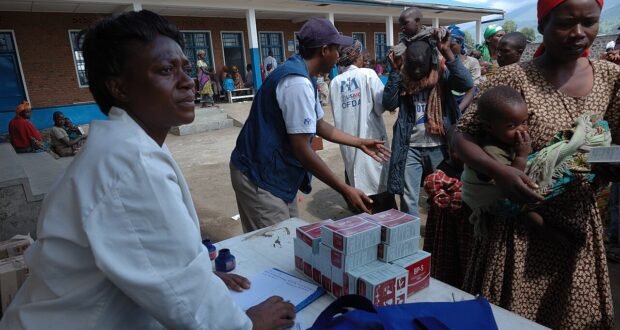
Image: A UNICEF worker is distributing high-calorie food during an emergency situation in Goma, in the Democratic Republic of the Congo, in 2008 (Source: Flickr user Julien Harneis via CC BY-SA 2.0)