 Human Security Centre Human Rights and International Security Research
By Sam Biden, Junior Fellow
29 January, 2026
On 2 September 2025, the United States launched a military strike against an alleged Venezuelan drug trafficking vessel, killing eleven individuals on board. In the months that followed, the Trump administration conducted at least ten additional strikes against vessels operating in the eastern Pacific Ocean and the Caribbean Sea. As of 15 December 2025, at least 95 individuals have been killed in a total of 26 reported US military strikes against vessels in the Caribbean Sea and eastern Pacific Ocean. President Trump justified these actions by claiming the boats were smuggling narcotics on behalf of the Tren de Aragua (TDA) gang, further alleging that TDA is a designated Foreign Terrorist Organization (FTO) operating under the direction of the former and now captured Venezuelan President, Nicolás Maduro. The totality of these strikes has been carried out without the public identification of any of those killed and the US government has provided no independently verified evidence to confirm the affiliations or identities of the individuals targeted, despite its claims of their involvement with FTOs. These strikes and the subsequent capture of former President Maduro raised serious questions over the continual use of force by the US, particularly when enforcing its own foreign policy objectives combating the trade of illicit drugs.
Broadly speaking, the attacks occurred as an extension of Operation Southern Spear (OSS). Originally soft-launched in September 2025, it was brought to light by Defence Secretary Pete Hegseth in November of that same year. Aimed at combating “narco-terrorist” organizations, OSS seeks to disrupt illicit trafficking in the Western Hemisphere as a means of safeguarding US national security. OSS comes at a crucial but also convenient time as the US Senate confidently voted against a resolution aimed at preventing the Trump administration from using force against Venezuela without Congressional approval shortly before the first waves of attacks. These attacks, while evidently motivated by a political desire to exert control over foreign policy relations with Venezuela, come as another piece of the puzzle that is the complex history of the US “war on drugs”.
In 1970, then-President Richard Nixon declared drug abuse to be “public enemy number one” and signed the Comprehensive Drug Abuse Prevention and Control Act, commonly referred to as the Controlled Substances Act (CSA). This initial legislation consolidated and replaced previous federal drug laws, establishing a comprehensive framework to regulate the legitimate pharmaceutical industry while criminalizing illegitimate forms, especially the developing drug trade out of South America. Alongside this legislative shift, the US created new institutional mechanisms, including the Drug Enforcement Administration (DEA) and the National Institute on Drug Abuse (NIDA), signaling a permanent expansion of the federal role in drug control and allowing Washington to hold a monopoly over domestic drug policy. Framing the issue of drugs as a national crisis, Nixon emphasized enforcement over prevention, arguing that public support was essential for the new legal regime to succeed. By the 1980s, newly sworn-in President Reagan increased pressure on the drug trade, signing key legislation such as the Comprehensive Crime Control Act (CCCA) and the Anti-Drug Abuse Act (ADA). The CCCA introduced heavy federal penalties, including new minimum sentences, enhanced punishments for trafficking narcotics, as well as asset forfeiture to financially harm drug traffickers, while the ADA established key governmental bodies to tackle domestic drug policy, such as the Office of National Drug Control Policy (ONDCP). The ONDCP became a powerhouse of US domestic and foreign drug policy, symbolizing the institutionalization of the war on drugs as a central pillar of US governance. In the 1990s, under the Clinton administration, US drug policy shifted toward supply-side interventions abroad, beginning the now greatly expanded role of the US in maritime seizures. While production declined in countries such as Peru and Bolivia, it simultaneously increased in Colombia with the continual rise of both the Medellín and Cali cartels, contributing to a net expansion in cocaine supply and forcing the US to take drastic diplomatic measures.
The US influence over international drug control expanded through both multilateral cooperation and bilateral agreements, particularly in Latin America and the Caribbean. Key to the latest attacks is the Caribbean Basin Security Initiative (CBSI). The CBSI originated in 2009 as a regional foreign assistance framework developed through consultation with Caribbean states. The initiative was designed to address shared security challenges by reducing illicit trafficking, strengthening public safety institutions and preventing youth crime and violence. Its creation reflected US concerns that intensified counternarcotics cooperation with Mexico and Central America could displace trafficking routes toward the Caribbean, cutting off key supply and production lines. At the time of CBSI’s establishment, many Caribbean states were experiencing persistently high levels of violent crime linked to drug trafficking and associated criminal networks, providing a strong incentive to cooperate with US maritime officials. This allowed the US to frame these challenges as a military threat, creating a structure focused on law enforcement rather than altering Central and South America’s already robust domestic drug policy. Specifically, these new enforcement mechanisms hinged on five areas; maritime and aerial security cooperation. law enforcement capacity building and training, border and port security measures aimed at intercepting narcotics/firearms and illicit financial flows, justice sector reform focused on enhancing the severity of punishments and the effectiveness of court systems and finally crime prevention initiatives targeting at-risk youth vulnerable to recruitment by criminal organizations.
New challenges regarding the lawful enforcement of these areas arose. Parties to the agreements had to consider not only domestic and foreign laws but also maritime law and the law of international armed conflict. In an attempt to accede to this complex list of requirements, the US and other Caribbean states signed the Agreement Concerning Co-operation in Suppressing Illicit Maritime and Air Trafficking in Narcotic Drugs and Psychotropic Substances in the Caribbean Area (US–Caribbean Anti-Trafficking Act, UCATA). Central to UCATA is a strict limitation on the use of force, reflecting longstanding international law principles applicable to law enforcement operations at sea. Article 22 states that force may be used only when no other feasible means of resolving the situation are available and any force employed must be both proportional to the objective pursued and limited to the minimum reasonably necessary under the circumstances, something direct airstrikes contradict. The agreement requires advance warnings prior to the use of force, except in cases of self-defence and prohibits force used as reprisal or punishment, especially in the pursuit of political objectives. Article 9 further clarifies the allocation of authority during joint operations. When law enforcement officials are embarked on another party’s vessel and exercising enforcement authority, all searches, seizures, detentions and uses of force must be carried out by those officials. Crew members of the host vessel may assist only upon express request and only to the extent permitted by the laws and procedures of both parties. Any such assistance, including the use of force, remains strictly governed by Article 22 and applicable domestic and international regulations. When these enforcement actions occur within the territorial waters of a participating state, law enforcement officials are required to respect the domestic laws of that state. This framework stands in solidarity with international regulations, yet in clear opposition to current practices employed by the US, which seek to justify lethal force under broader national security claims.
The key question now remains – does the Trump administration have the legal right to use force?
Use of Force
The Trump administration has consistently framed the maritime strikes as acts of self-defence against armed attacks by narco-terrorist organizations, under which they could be legally justified. On September 4 2025, President Trump asserted that the operations were carried out pursuant to his constitutional authority to safeguard US interests abroad and advance national security objectives.
Under Article 51 of the United Nations Charter (UNC), states retain an inherent right to self-defence in response to an armed attack, with narrow definitions extending to anticipatory self-defence where an attack is imminent. In this instance, the attack must meet standards of necessity that deem the need to use force as “instant, overwhelming, leaving no choice of means and no moment for deliberation”. Therefore, the Trump administration must clearly establish that the vessels in question posed an imminent threat to the US, that the threat was great enough to warrant the destruction of the vessel and that this destruction occurred instantaneously as a direct result of this threat. While the trafficking of drugs poses a very real threat to public health and safety, as well as border security for the US, standalone vessels, even if manned with armed guards, do not present a threat so great as to justify their immediate destruction with no consideration otherwise.
The vessel struck on 2 September was reportedly unarmed, had reversed course toward the Venezuelan coastline and was not conclusively shown to be bound for the US, despite the Trump administration claiming otherwise. In an effort to justify the attack, the administration later issued an executive order classifying fentanyl as a weapon of mass destruction, arguing that foreign terrorist organizations exploit its distribution to threaten US national security. Although fentanyl poses undeniable public health risks, it remains an FDA-approved Schedule II substance routinely used in clinical settings, therefore, the re-categorization was of little utility. Compounding this issue is the success of the Colombian Navy during the same period, intercepting and seizing more than seven tons of cocaine, alongside arresting suspects and subjecting them to criminal prosecution without the use of military force. Further details surrounding the 2 September attack place the US at real risk of violating international regulations as well. Testimony from the administration contended that the drugs aboard the vessel constituted the primary threat, effectively characterizing the cargo itself as a weapon and providing some justification for its destruction. However, the administration further argued that the two survivors remained lawful targets because the overturned vessel might still contain narcotics and because the individuals could potentially obtain assistance or resume trafficking activities, despite their chance of resuming such activities being slim.
In parallel, the US has a duty to constantly re-assess the legality of an attack, or pre-planned attack in this case, as drug vessels are officially listed as valid targets by the US. The administration claims that a second strike on the vessel was necessary to eliminate the threat of both the drugs and the men on board, despite them being unarmed and potentially protected as “shipwrecked” persons within the meaning of Geneva Convention II. The fragile nature of the administration’s legal arguments concerning the second strike reinforces broader doubts about the legitimacy of the campaign, raising the question of how many unarmed civilians may have been unlawfully killed.
Conclusion
Operation Southern Spear ultimately reveals a significant and unsettling expansion of US force beyond established limits of international law. By classifying drug trafficking as an armed attack and presenting enforcement measures as acts of self-defence, the Trump administration has eroded the distinction between law enforcement and warfare. The clear necessity leaves the US on precarious legal footing and in open tension with international maritime law, which if left unchallenged, this overly securitized approach risks embedding lethal force as a standard tool of foreign policy while simultaneously recasting counter-narcotics operations as a closed process requiring lethal force not as consequential, but mandatory.
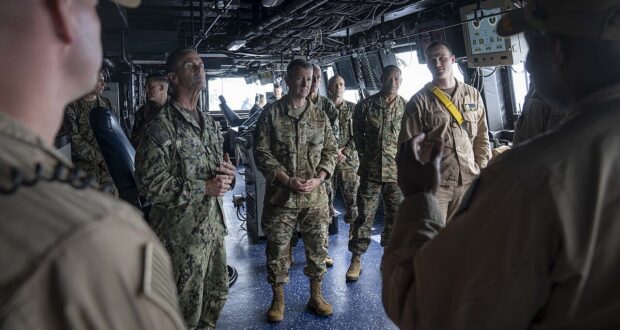
Image: General Dan Caine and Senior Enlisted Advisor to the Chairman David Isom meet with sailors and Marines aboard the USS Iwo Jima in the Caribbean Sea, 8 September 2025 (Source: Chairman of the Joint Chiefs of Staff/Public Domain)