 Human Security Centre Human Rights and International Security Research
3 August, 2026
By Irena Baboi – Senior Fellow
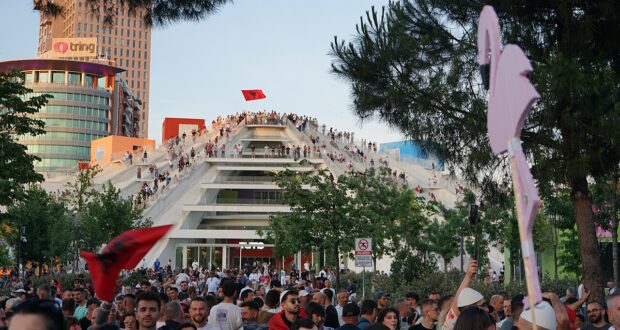
On 23 May 2026, protests erupted in Albania over the planned construction of a luxury resort linked to United States President Donald Trump’s daughter Ivanka and her husband Jared Kushner in a protected area of the country. By mid-June, the narrow environmental protests turned into a nationwide campaign directed at Albania’s entire political establishment. Carrying inflatable flamingos and signs reading “Albania is not for sale”, tens of thousands of Albanians have joined the rallies in Tirana and other cities in and outside the country, many of them travelling from the United States and other parts of Europe to add their voices to the wave of dissent. Demonstrators are now calling for the resignation and even imprisonment of Prime Minister Edi Rama and opposition leader and former premier Sali Berisha, the two longest-serving leaders who have dominated the political landscape since the fall of communism in 1991. Albanians, however, are not just protesting against Rama and Berisha – years of perceived government corruption, unchecked tourism, frustration over Albania’s economic development and a general perception that the country is being run for the wealthy few rather than the general population have reached a breaking point, prompting the biggest popular demonstrations in Albania’s democratic history.
In April, bulldozers began clearing clusters of forest and ancient dunes to make way for construction in a protected conservation zone across the water from Sazan, Albania’s only island, a former military base located at the entrance to the Adriatic Sea. A concrete-based, barbed wire-topped fence was erected around the site near Zvërnec, and a private security firm was installed to protect it, effectively blocking locals from accessing their properties and the local beach. At the end of May, environmental groups and local residents began protesting the development’s encroachment on the Pishë-Poro-Nartë protected area, a sensitive Mediterranean wetland critical for flamingos and nesting sea turtles. Public outrage rose when opponents to the development of the 10,000-room resort on the peninsula confronted private security contractors, and viral footage of the clashes showed a guard punching and dragging a protester away from the fenced-off beach while present police officers chose to not intervene. The incident caused the protest movement to expand to the country’s capital Tirana, and demonstrations quickly spread to other cities in Albania, Kosovo and countries abroad that have Albanian diaspora communities.
The Pishë Poro-Narta reserve, home to one of Europe’s last wild rivers, encompasses much of the Zvërnec peninsula, its sandy shores protecting an inland lagoon that is an important habitat for flamingos, monk seals and loggerhead sea turtles, and a major migratory route for hundreds of rare birds and more than seventy endangered species. The planned luxury resort is intended to cover an area that not only includes the uninhabited outcrop of Sazan, but also the wetlands and coastal habitats in the marine national park that surrounds it. The waters here are among the last refuges for the Mediterranean monk seal, with the area also sheltering more than two hundred bird species – many endangered – including flamingos and Dalmatian pelicans. Areas of protected coastal landscape, north of the village of Zvërnec, between the lagoon of Narta and the sea, are also reportedly earmarked for development by Jared Kushner’s investment firm, Affinity Partners.
The development of the 10,000-room luxury resort was granted preliminary approval in 2024, after the Albanian government amended stringent laws safeguarding environmentally sensitive zones. A wave of demonstrations took place when the government adopted the controversial legislation, which paved the way for infrastructure and tourism developments inside protected zones, posing a severe threat to Albania’s biodiversity and fragile ecosystems. Highlighting the perceived lack of transparency around the project, protesters claim they have seen no public consultation or public documentation regarding permits, and that the investors remain a mystery, their identities concealed behind a multi-layered shell company in the Netherlands. In June, a BIRN investigation revealed that, according to documents obtained via Freedom of Information requests, the project involves a network of individuals and firms, among them a businessman accused of ties to the Italian mafia, a former judge who chose to resign rather than face scrutiny over the origin of his assets, and individuals connected to one of the country’s most powerful business figures, Shefqet Kastrati. Albania’s National Council for Territory and Water (KKTU), chaired by Albania’s Prime Minister Edi Rama, has issued the project a development permit, despite ongoing legal disputes over who in fact owns the land on which the resort would be built.
At the beginning of June, Albania’s Special Structure Against Corruption and Organised Crime (SPAK) launched investigations into land deals connected to the luxury resort development following allegations of forged titles and other irregularities. Anti-corruption prosecutors froze the bank accounts of Albania Land Development, a landholding company tied to the controversial luxury resort project. The company, owned by the prominent Qatari entrepreneurs Moutaz and Ramez Al-Khayyat, is said to have recently purchased beachfront plots in Zvërnec from Artur Shehu, a Miami Beach developer who has been identified in a different SPAK investigation as a suspect of offences including money laundering and participation in an organised crime group. Prosecutors conducting the SPAK investigation on property secured for the planned luxury resort allege that much of the land designated for the luxury resort was previously acquired by Shehu using forged documents, as there have been “longstanding and ongoing conflicts over time among several individuals, residents of the area, who claim ownership” of the land sold for the project.
While the protest movement began as objection to the planned development of the luxury resort, the demonstrations quickly evolved into broader opposition against the government of Albania’s Prime Minister Edi Rama, systemic corruption, state and media capture, poor governance and democratic backsliding. As part of their demands, protest organisers have outlined a five-point platform that includes a constitutional limit restricting any individual from serving more than two terms as prime minister; electoral reform and changes to political party financing regulations; the drafting of a new constitution to guarantee full equality before the law, subject to approval through a national referendum; the establishment of a non-partisan transitional technical government with a clear twelve-month mandate; and the immediate resignation of Prime Minister Edi Rama and his entire government cabinet. Protesters have also outlined a series of economic and environmental demands, including the repeal of amendments to legislation concerning protected areas and cultural heritage, the cancellation of the so-called “Mountain Package” – a law that opens the way for large scale constructions and investment projects in forests and pastures, which risk harming Albania’s ecological and biodiversity values –, and the abolition of the legal framework governing Strategic Investments, which has raised concerns about transparency and equitable access, favouritism and a lack of competitive processes.
Amid these anti-government protests and daily calls for his resignation, Edi Rama has chosen to stand his ground. The Albanian Prime Minister has defended the luxury resort project, arguing that the concerns expressed by demonstrators are based on “misinformation and false reports”. Rama has also described the €4 billion (£3.4 billion) development project as “vital” if Albania is to become the Mediterranean’s “most attractive high-end tourist destination”, and has repeatedly called what is Albania’s biggest investment ever “a blessing” that will not only provide badly needed jobs but “ultimately result in approximately 25% more trees and green space”. While the mainstream media outlets in Albania initially attempted to ignore or downplay the unrest, Rama argued it is Jared Kushner’s involvement, rather than environmental concerns about the project itself, that seemed to be fuelling the protests, and attracting media attention. At the beginning of June, the Albanian prime minister proposed to meet protesters and discuss the situation, but stressed that there is “absolutely no chance that the investment will stop as long as I am here”. The protesters have refused to meet with the prime minister, and will continue taking to the streets until he agrees to their demands.
For years, Edi Rama’s assertive leadership style was seen as a necessary evil, the cost of him pushing forward difficult but important processes, most notably European Union accession and the reforms required to achieve this. The veteran socialist, once praised by the European Union for his visionary policies, was elected for a fourth term last year on a vow to bring his previously isolated country into the European Union. In a country where more than 90% of citizens support European integration, this vow was enough to win Rama his re-election. It is worth noting, however, that turnout was historically low, even with the extension of the vote to the diaspora for the first time. Over time, Rama’s leadership style has increasingly become associated with the concentration of power and decision-making, often at the expense of democratic procedures such as parliamentary dialogue or civil society consultation. Now, after long being seen as a frontrunner alongside Montenegro to become a member by 2030, Albania’s ambition to join the European Union hangs in the balance, as both the European Commission and the European Parliament have expressed concerns over the ongoing political unrest and environmental destruction.
On 7 June, the European Commission warned Albania that it must act now to avoid jeopardising its bid to join the bloc, which requires the Western Balkan candidate country to comply with European Union environmental rules. Commission spokesperson Guillaume Mercier said that “Albania should refrain from actions that could undermine the fulfilment of the closing benchmark, in this case Chapter 27, and so we expect the Albanian authorities to act without any delay”. On 17 June, the European Parliament expressed serious concern over ongoing developments in the Vjosa-Narta protected area, and called for a moratorium on new permitting procedures, construction works and development interventions within protected areas until incompatible provisions of Albania’s amended Law on Protected Areas are repealed and full compliance with European Union nature protection standards is ensured. In response, the Albanian prime minister initially argued that the quality of the environment will in fact improve as a result of the investment, and pledged to continue the Zvërnec development “based on an environmental impact assessment according to European Union standards”. However, in mid-July, during a joint conference with European Commissioner for Enlargement Marta Kos in Brussels, Rama promised to change the country’s disputed Law on Protected Areas to align with European Union standards – a declaration that protesters at home celebrated as a “moral victory”.
With respect to the protesters’ other demands, the Albanian Prime Minister is yet to address them. Unprepared for the demonstrations to evolve into a movement and gain international attention, Edi Rama has instead used every tool in the autocrat’s handbook to try to undermine them. The Albanian Prime Minister initially sought to minimise the size and significance of the demonstrations, saying that participation was far lower than reported and accusing international media and social networks of creating a “digital hysteria” around the issue. Rama has also described some protesters as “ignorant”, “delusional” and lacking logic, and argued that the demonstrations were harming tourism and the local economies. At the beginning of July, when protests outside the Parliament escalated, Rama’s government used police to disperse the protesters with water cannons, tear gas and pepper spray, and issued arrest warrants for some of the most prominent figures in the protest movement. Rama then used the pro-government media to brand the protesters as traitors, and claim that they were against the interests of Albania. Unwilling to back down or moderate his belligerent response, the Socialist Party leader went as far as to say that, for the government, “Foreigners are the first priority … because foreigners bring money to the country for Albanians”.
As the protests have grown, Edi Rama’s rhetoric has become increasingly confrontational. The Albanian prime minister has classified the protests as part of a “hybrid war” prompted by regional envy of Albania’s rapidly growing tourism sector, claiming that the country is “under attack from very strong competition in our part of the Mediterranean”. This is a reference to Greece, which Rama has accused of trying to undermine what he describes as a historic investment for Albania. In response to Albanians taking to the streets every day since the end of May, Rama has denounced the protesters as extremists, and accused them of resisting a project that is in the interests of Albania. The Albanian prime minister has also said the demonstrations are orchestrated by political rivals, and accused foreign agents, including from Iran, of fuelling the unrest. The spokesperson of the Iranian Ministry of Foreign Affairs, Esmaeil Baqaei, rejected the statements of the Albanian prime minister, characterising them as baseless. In his public reaction, Baqaei asked Rama to respect the judgment of the Albanian citizens, arguing that the protests are the results of an internal grievance and not Iranian influence.
The current protests represent a significant moment in Albania’s democratic history, and a powerful shift in the people’s relationship with their political elite. A country with very little tradition of civic unrest, Albania was under one of the most repressive regimes in Europe after the Second World War, a communist dictatorship that maintained complete control over its population through fear, indoctrination, and division. For nearly fifty years, the notorious “Sigurimi” secret police and labour camps silenced dissent, while purges and mutual surveillance cultivated deep-seated societal distrust. The education and media were completely controlled by the state, and the system was defined by a rigid cult of personality, a ban on religion, and total isolation from the outside world. Albania’s totalitarian system left powerful legacies, including mistrust in public institutions, the expectation that power and authority cancel the need to show accountability, and the assumption that public protests are dangerous and futile, leading many Albanians to choose political apathy as their response to injustices. Albania’s transition to democracy has also been painfully slow and marked by systemic corruption and waves of youth emigration, with many Albanians believing it is not worth staying and trying to change the system in their country.
In recent years, moreover, Albania has become an increasingly popular destination for visitors attracted by its natural beauty and affordability. The push for foreign investment has tripled the number of visitors in the last decade, with upwards of twelve million tourists – more than four times the country’s population – visiting Albania last year. The speed of development, however, has come at a cost, as luxury tourism has put stress on the environment while bringing few economic benefits for Albanians. Housing and real estate prices have sharply increased both in Tirana and the coastal areas, making them unaffordable for many of the country’s citizens. Young Albanians are leaving the country at the highest rate in Europe, as foreign investments have not translated into work opportunities and better living standards for the people of the country. After thirty-five years of democracy, Albanians are very much aware that it is because of poor governance and the failures of the entire political class that their country has not achieved the standards promised by their ruling elite. Above all, the people out on the streets are calling for better living standards, better schools and hospitals, and better overall conditions, which would mean Albanians no longer needed to leave their country in search of a better future.
The planned construction of the luxury resort has exposed every flaw of the Albanian system: political corruption, lack of transparency, the power of the oligarchs, the control over police and mainstream media, and the close relations between Albania’s political elite and a handful of rich families with outsized influence in the country. In its 2025 report, Freedom House classified Albania as “partly free”, and stated that corruption and bribery remained major problems despite reforms in the justice system. The Freedom House report also noted that Albania has a record of competitive elections, but political parties are highly polarised and often organised around leading personalities. Since the early 1990s, Albanian politics have been dominated by two major parties: the Socialist Party (PS) led by Edi Rama, which has been in power since 2013, and the Democratic Party (DP) led by Sali Berisha, who was President of Albania from 1992 to 1997 and prime minister between 2005 and 2013. This two-party dominance has left little room for credible political alternatives to emerge, while political polarisation, lack of genuine political dialogue and clashes between the ruling majority and parts of the opposition continue to impede the Parliament’s activity. Following the parliamentary elections that took place in May 2025, the Organisation for Security and Cooperation in Europe (OSCE)/Office for Democratic Institutions and Human Rights (ODIHR) election observation mission noted that elections were competitive and professionally conducted, but identified some shortcomings, including the lack of a level playing field and abuse of public resources. Both the ruling elite and the opposition have also been involved in serious corruption scandals, and both sides are responsible for people’s loss of trust in, frustration and fatigue with the entire Albanian political establishment.
Regardless of their eventual outcome, the current protests represent a turning point in Albania’s history. The tens and hundreds of thousand of Albanians taking to streets every day since May have made it clear that they want Albania to be a country where people feel safe, see a future for themselves, and are not forced to leave in search of better opportunities abroad. After years of compromise and broken promises, the Albanian people have reached their limit – and there is no going back now that they have made it clear they will no longer tolerate business as usual.
Image: Protests against the government (Source: Albinfo via CC BY-4.0)