 Human Security Centre Human Rights and International Security Research
By Oliver Hegglin, Junior Fellow
23 February, 2026
In January 2026, United States President Donald J. Trump repeated rhetoric he had initially stated during his first term on his goal to acquire the autonomous Danish island territory of Greenland (Kalaallit Nunaat). While his then objective was passed off, US military action in Venezuela shortly before re-stating his desire to acquire Greenland caused serious concern that his desire for expansion was meant in sternness. President Trump has further accused NATO ally Denmark of being unable to defend the world’s largest island, at nearly two-million square kilometers and almost permanently ice-covered, thereby justifying US ownership on national security grounds. This warrants understanding the threats facing Greenland as well as its security architecture pre-2026, in order to measure developments made to address US security concerns and increased military posture on the island.
Understand Greenland’s security architecture requires first realizing its value – its strategic geography. Forming both the northern end of the Greenland – Iceland – UK (GIUK) Gap, and serving as the northern-most point of the American continent, Greenland has been significant for early-warning and radar-tracking, able to detect threats transiting over the Arctic before reaching Canada and the United States. During the Cold War, American installations surveyed the air for hostile aircraft and missiles, and the waters for Soviet submarines crossing into the NATO patrolled Atlantic Ocean. In recent times, the GIUK Gap remains significant considering Russia’s revanchist foreign policy and increased Chinese military activity in the Arctic. The increased significance of space in contemporary geopolitics has also caused Greenland to emerge as a central node in space domain awareness and satellite tracking, crucial for modern communications and navigation. Receding ice also means an increase of economic and military activity in the Arctic. Yet despite this, Greenland’s naturally defensive location has never served to place massed armed forces.
The Kingdom of Denmark
As a territory of the Kingdom of Denmark, Greenland exercises extensive self-governance with the 2009 Act of Greenland Self-Government, recognizing Greenland under international law and by the Kingdom of Denmark as entitled to self-determination. Matters of foreign and security affairs remain in the hands of Copenhagen, making the defense of Greenland a Danish responsibility. This results in a layered approach, comprising of a Danish military presence, NATO collective defense, EU support, as well as a bi-lateral agreement with the United States.
Already prior to 2026, Copenhagen planned for an increase in assets and finances for Greenland under the kingdom’s 2024-2033 Defence Agreement. For the area under the purview of the Danish Armed Forces’ Joint Arctic Command, headquartered in the Greenlandic capital Nuuk and comprising of Greenland and the Faroe Islands, two subsequent agreements, the First Agreement on the Arctic and North Atlantic and the Second Agreement on the Arctic and North Atlantic, lay out the future defense plan for Greenland.
Amounting to a total of 42 billion Danish Kroner (approximately €5.6 billion/$6.7 billion), the agreements are designed to “assert sovereignty in the regions” and call for the acquisition of five new Arctic-capable ships, 16 additional F-35 fighter jets, maritime patrol aircraft, two long-range surveillance drones, space- and ground-based sensors, several facility upgrades, and an extension of military training for Greenland’s youth, among other points.
Nuuk
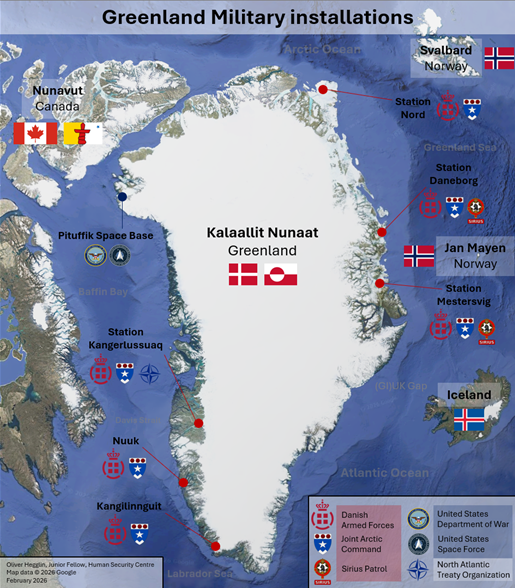
Responsible for maritime and airspace monitoring, search and rescue, law enforcement, and sovereignty missions, the Joint Arctic Command comprises personnel from all branches of the Royal Danish Armed Forces. It is set to acquire new headquarters with the capacity for future operations, as well as housing for temporary reinforcement and a dedicated naval quay in the port of Nuuk. On Greenland, the Joint Arctic Command oversees five other facilities.
Kangerlussuaq
The most significant military facility on Greenland is the airfield in Kangerlussuaq, some 320km north of Nuuk. Established in 1941 by the United States and designated as a strategic NATO site in 1951, the facility at Kangerlussuaq came under Greenlandic control in 1992. Since then, it has not served as a permanent military base but as an irregular host of Danish forces. This changed in 2024, when Denmark revealed plans to make the airbase operational in line with Defense Minister Troels Lund Poelsen’s emphasis of a “larger, more permanent presence” on Greenland.
As part of the aforementioned agreement, buildings and the runway are to be renovated, able to periodically support F-35s and the long-range drones listed in the same agreement. NATO allies are also supporting the installation with an optical ground station. Kangerlussuaq is a logical, if not the only viable, location for this, as it is the only Danish-run military facility on Greenland with existing infrastructure that can be modernized and designated as a NATO-compatible operating location, as it was in the past.
Kangilinnguit
Similar to the facility at Kangerlussuaq, the United States built a facility at Kangilinnguit during World War Two, approximately 375km south of Nuuk, and operated a cryolite mine at nearby Ivittut, sourcing the mineral which was crucial in aluminum production for aircraft construction. In 1951 the military facility was handed over to Denmark and renamed Grønnedal naval base, serving as the headquarters of Danish forces on Greenland and as NATO Island Command Greenland as part of Allied Command Atlantic. With the establishment of the Joint Arctic Command in 2012 and its headquarters in Nuuk, the outpost at Kangilinnguit was repurposed into a logistics hub with its dock able to accommodate ships for resupply and maintenance.
Daneborg and Mestersvig
The Greenland National Park, covering the north and northeast of the island, is remote and inhospitable 972,000 square kilometers with about 80% permanently covered by the Greenland Ice Sheet. Responsible for asserting Danish sovereignty over this uninhabited area is the Sirius Dog Sledge Patrol. Established in 1950 for systematic surveillance of this area, Sirius has been part of Joint Arctic Command since 2012, serving as a special forces headquartered at Station Daneborg with an additional training facility at Station Mestersvig.
Following years of Arctic warfare training, six teams, each made up of two soldiers and between eleven to 15 specially-bred Greenland huskies, conduct long-range monitoring missions for up to five months at a time in near-total isolation where the winter brings constant darkness and temperatures of -55C. Because these conditions make modern technology and machinery obsolete, these “sovereignty patrols” are the only way in which Denmark can fulfil its international legal obligation to assert a visible continuous presence over Greenland’s national park.
The Sirius Patrol is one of Denmark’s three special forces units, along with the Jaeger Corps and the Frogmen Corps, both of which also undergo specialized Arctic environment training. And as per the aforementioned defense agreements, an additional specialized unit focusing in the Arctic environment and operating in conjunction with Sirius will be established.
Nord
Initially established as a weather station in 1952, Station Nord is the sixth Danish military facility on Greenland, acquired in 1975. An airstrip enables access to an otherwise inaccessible facility, enabling a permanent presence in the island’s far north which also hosts Villum Research Station.
The North Atlantic Treaty Organization
Since the establishment of the North Atlantic Treaty Organization, Greenland has held strategic value in the alliance’s overall defense strategy due to its geography. As a part of the Kingdom of Denmark, it is protected by NATO’s Article V collective defense in case of an armed attack, as per Article VI of the North Atlantic Treaty, which includes “the territory of any of the Parties in Europe or North America”. While it is up to each ally to determine in what way they respond to an armed attack, should the North Atlantic Council decide that such an event did in fact take place, Article IV, which calls for consultations, can be invoked by a single member. NATO builds its Article V on United Nations Charter Article 51, another layer of security for Greenland, which recognizes the right of a state to individual or collective defense.
The European Union
While not a military alliance like NATO, the European Union possesses a mutual defense clause in the Lisbon Treaty, Article 42.7. This clause stipulates an “obligation to aid and assist” a member state that has become the victim of aggression on its territory. This, also in accordance with the UN’s Article 51. Unlike NATO’s Article V, which requires unanimity, any EU member state can invoke Article 42.7. EU states are free to act individually and assistance can range from diplomatic support to military aid. The EU’s Defense Commissioner, Andrius Kubilius, has confirmed that Article 42.7 applies to Greenland. However as the clause is vague, Kubilius has indicated desire to develop it with a clear procedure and integrated military command. Currently, 42.7 relies on solidarity and serves more as political deterrence rather than an obligation.
The United States of America
For the United States and Canada’s North American Aerospace Defense Command (NORAD), Greenland’s geography is essential for aerospace and maritime control and warning, as outlined in the US’s 2024 Arctic Strategy. This history goes back to the 1951 Defense of Greenland Agreement between the Kingdom of Denmark and the United States. The agreement came as a result of NATO direction to ensure the defense of the North Atlantic Treaty area by giving the US perpetual access to the island with the permission to build facilities needed for defense, as long as NATO continued to exist.
Denmark’s sovereignty over Greenland was reiterated with the agreement, first recognized in the 1917 Convention Between the United States and Denmark for the Cession of the Danish West Indies. As long as it did not violate established Danish sovereignty, the United States is free to act on the island, limited only by few political constraints. A 2004 update recognized the role of Greenland’s Home Rule government (Naalakkersuisut). The US would retain its military liberties, but should consult both Denmark and Greenland prior to any “significant changes”.
Pituffik
The largest military installation the United States built on Greenland, housing over 10,000 soldiers at its height and its worldwide northernmost, was Thule Air Base, constructed in 1951 and 1952 with Danish permission. Located about half-way between Washington DC and Moscow, Thule hosted strategic bombers and reconnaissance aircraft, interceptors, and surface-to-air missiles. Its location meant it is integral to North American defense and would likely be the first facility on the continent targeted in the event of a then Soviet, today Russian, attack.
Renamed to Pituffik Space Base in 2023 to reflect its role in the Space Force, to which it had been transferred in 2020, and to recognize local cultural heritage, it is the only active foreign military installation in Greenland and staffed by some 150 personnel. The facility retains its significance as a hub for US and NATO missile warning and defense, satellite and space surveillance, and Arctic monitoring. It also hosts air defense exercises with partners like Canada and acts as a logistics hub for transport, and search and rescue operations.
Greenland
Prior to 2026, Greenland had not been conventionally militarized. The military facilities on the island and its multi-layered defense architecture have sufficed to address the threats that faced the North American continent rather than the island directly. Its military value remains in strategic depth as a northern node in the Arctic. And despite its natural geography seriously limiting conventional military value and making offensive attempts severely difficult, Denmark and NATO have taken steps to strengthen Greenland’s layered defense already prior to 2026.
This is justified by Russia’s continued militarization on its side of the Arctic, by perceived Chinese encroachment in the region, and by their existing military cooperation, not due to threats made by the White House, as Major General Soren Andersen, head of the Joint Arctic Command, has clarified. While Danish intelligence has identified no “imminent” threats from Russia or China, several NATO members have indicated intent to increase their military presence in Greenland and participate in exercises, such as Arctic Endurance, as part of overarching Arctic security.
NATO’s Secretary General Mark Rutte responded to President Trump’s accusation that Greenland is vulnerable by stating that the alliance was working on “next steps” concerning Arctic security. The result was the announcement one month later that a new initiative, Arctic Sentry, responsible for the “planning and execution of all NATO exercises, activities and operations” in the Arctic, had been established. This builds on US and NATO agreements that more should be done in the Arctic to counter growing Russian and Chinese activity.
Kalaallit Nunaat
In January 2026, both the Governments of Greenland and Denmark agreed on increased Danish military activity and closer NATO cooperation in the form of personnel, aircraft and vessels, and through exercises in Arctic conditions and in guarding Greenlandic infrastructure. The Joint Arctic Command headquarters in Nuuk is to see such an increase, as is the base at Kangerlussuaq, aiming to show allies that Denmark can fulfil its expected responsibility as guarantor of Greenland’s security and sovereignty. High-level bi-lateral exchanges between Denmark and the United States continue, and in parallel to planned expansions to Danish military facilities on Greenland, Pituffik Space Base is also expected to improve facilities and add equipment to its inventory.
Greenland lacks the military resources, infrastructure and overall capacity for defense in an increasingly militarized region. Soft-security and hard-defense has therefore been built in a multi-layered, multi-lateral architecture that integrated Greenland into a greater North Atlantic defense scheme. Greenland’s Foreign Minister Vivian Motzfeldt has stated that the island was committed to finding the “right path” to security cooperation, which includes a United States presence, however not at the cost of sovereignty. The island’s government has also indicated their desire to improve their defense through NATO integration, underlying that the United States and NATO as a whole have an interest in Greenland’s defense.
To this end, the existing military facilities in Nuuk, Kangerlussuaq, Kangilinnguit, and of Stations Nord, Daneborg, and Mestersvig, as well as the capabilities of the Sirius Patrol, the Joint Arctic Command, and of its international partners, have evolved over decades to secure sovereignty over the island and develop its value in seeing and anticipating threats to the North Atlantic. Unique capabilities have been established in a place where nature has imposed limits to militarization, creating a need for cooperation in a rapidly transforming part of the world.
Post-2026, Greenland will have to face the realities of its economic and defensive dependencies in its path towards independence. While a split from Denmark is the ultimate goal with broad local support, there is the recognition that the island relies on Denmark not just for defense, but also for healthcare, education, policing, its judicial system, and its economy, through an annual block grant of some 6.3 billion Danish Kroner (about €840 million/$1 billion). To achieve independence, a seven-step plan, beginning with a formal declaration of intent and which includes a public referendum, can be initiated, as per Chapter 8 of Greenland’s 2009 Act on Self-Government. For the time being however, the population is divided on how, and when, to achieve independence. Until the island’s institutions can function independently from Danish support, and until Greenland can ensure its own security and assert sovereignty over its territory, the Naalakkersuisut will not commence independence proceedings.
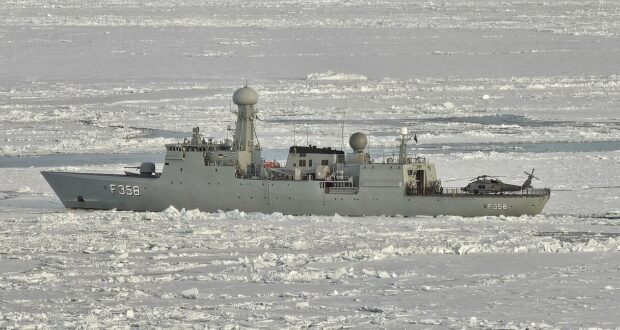
Image: HDMS Trition (Frigate 358) on patrol in the frozen Fjord near Ilulissat – Greenland on March 31., 2024 (image cropped) (Source: DivatorMKII via CC BY-SA 4.0)