 Human Security Centre Human Rights and International Security Research
4 April, 2025
by Oleksandra Zadesenets, Senior Fellow
Summary
Grey-zone activities operate between peace and war. Estonia faces a surging online pro-Russian movement promoting the “Narva People’s Republic”. This movement promotes satiric messaging and distinct quasi-national symbols to construct a separate political identity. Anti-Estonian narratives and calls for autonomy create vulnerabilities that Russia could exploit to weaken European security and entrench its political influence. The primary objective of the Estonian government, thus, is not to suppress these narratives outright, but to prevent them from evolving into an accepted justification for political intervention. Engaging fact-checking platforms and a targeted counter-meme strategy can disrupt informational manipulation and strengthen societal resilience. By adopting this policy, the Estonian government can achieve dual objectives: safeguarding sovereignty and upholding democratic legitimacy.
Context
In recent weeks, Estonia’s information space has witnessed a rise in alleged pro-Russian separatist movements in Estonia. The Telegram channels and the Vkontakte network have been actively promoting the idea of a “Narva People’s Republic”. Narva is a city on the border with Russia, where roughly 90% of the population is Russian-speaking and has family ties in Russia. This geographical and cultural layout makes this population particularly vulnerable to political manipulation by the Russian Federation.
- The rejection of any separatist intentions to break Narva and Ida-Virumaa away from Estonia and to overthrow the Estonian government.
- The promotion of autonomy, self-determination, and “equal status for Russian non-citizens alongside Estonians.”
Users rely on familiar meme templates and provocative jokes to highlight (a) the resentment towards the Estonian government based on the perceived discrimination against the ethnic Russian community; (b) the celebration and strengthening of a distinct Russian identity in Estonia.
The community developed a distinct discursive and visual branding for the “Narva People’s Republic.” Its unique flag, coat of arms, and military insignia indicate a coordinated effort to present Narva as a distinct political entity. The anthem, a Russian song “Fly Away on the Wings of the Wind”, reinforces this message by implicitly calling for “unification with the Motherland.” Cognitively, such narratives gradually shape separatist perceptions and amplify grievances within the targeted Russian-speaking audience, potentially generating support for vigilante responses to perceived injustices and external intervention from the Russian side.
Threat Perceptions & Strategic Communications
The surge of pro-Russian sentiments closely resonates with the “people’s republics” orchestrated by Russia in eastern Ukraine in 2014. The deliberate mobilisation of separatist actors was a central tool in the early stages of Russia’s war against Ukraine and its broader expansionist agenda in the post-Soviet space.
Opinions, however, differ on whether this close historical parallel constitutes a credible threat to Estonia’s territorial integrity. Shortly before the surge of “Narva People’s Republic” messages, analysts at the Belfer Centre had forecast that Russia was likely to intensify its grey-zone activities against NATO countries over the next three years, culminating in military action along NATO’s northeastern frontier. This line of analysis interprets the online activity of the “Narva People’s Republic” as a strategic instrument of Russian foreign policy. Its purpose is to escalate the societal tensions and prepare the informational space for either the annexation of the Estonian territory or the launching of a full-scale attack on the Baltic states.
Amid persistent warnings from media groups and think tanks, Estonian authorities have deliberately avoided framing this phenomenon as an immediate security crisis. The Estonian Minister of Foreign Affairs clearly framed this online activity as a targeted attempt to sow confusion and weaken social cohesion. This rhetoric mitigates the threat’s salience among the Estonian population and emphasises information awareness as the primary countermeasure. While the Estonian government retain the realistic assessment of the Kremlin’s expansionist ambitions, it states that Russia is not currently in a position to invade Estonia due to the battlefield losses incurred in Ukraine.
Why the “Narva People’s Republic” demands closer monitoring
The threat posed by the “Narva People’s Republic” does not warrant immediate alarm; the Estonian government’s response is proportionate and fair. The pragmatic approach in managing separatist messaging maintains public confidence in Estonia’s defence. Yet several factors indicate that this threat warrants closer scrutiny in the long run. The primary risk to Estonian national security lies not in immediate military escalation, but in the gradual amplification of vulnerabilities that can be exploited over time.
Although such an online activity resembles recognisable patterns of Russian information warfare, direct evidence of Russian involvement remains inconclusive. However, attribution is ultimately secondary to impact. Be they orchestrated by Russia or self-conceived grassroots initiatives (as stated by the administrators of the Telegram channel “Narva People’s Republic”), the effects of such informational campaigns remain the same: they create conditions that could be of strategic value to Russia.
One of the key narratives promoted within this online space is the perceived unequalities between the Russian and Estonian populations and the absence of legal provisions for regional autonomy in Estonia. The latter is framed as a solution to these grievances. This narrative aligns with Russian geopolitical messaging. This can directly trigger the Russian compatriot policy (Россотрудничество). Compatriot policy posits that Russia has a legal and moral responsibility to intervene in the neighbouring countries to defend ethnic Russians. Historically, it had served as a pretext for the territorial invasion and a political tool for strengthening Russian cultural identity and political influence, as evidenced in Crimea, Donbas, Abkhazia, South Ossetia and Transnistria.
A central issue demanding immediate attention from the Estonian policymakers and international community is that the humour promoted by this online community is often intertwined with calls to action. One meme-style publication, for example, described the Narva militia’s daily schedule, outlining the storming of Narva as a central activity. The satiric framing allows this community to operate in the unsanctioned grey zone while avoiding accountability. At the same time, these formats remain engaging and accessible. It facilitates participation and recruitment through digital presence.
Post-irony helps to mask the intent and deliberately keeps it controversial, while the audience clearly perceives the underlying message: “the Russian-speaking are discriminated against, and their needs go unaddressed by the Estonian government — this must change”. As users interact and share these narratives, they reinforce them and increase the perceived legitimacy of Russia’s role as a protector. Russia can further capitalise on this grey-zone activity and steer radical anti-Estonian behaviour
a) infiltrating its agents into these online networks to prepare the informational space for the coordinated insurgency that can be framed as a grassroots rebellion;
b) disseminating propaganda that amplifies the messages of the “Narva People’s Republic” to a broader audience. Given that the recent journalistic investigation established that NarvaNews promotes Kremlin narratives under the guise of local coverage, this task would be relatively straightforward.
c) Since Estonia’s “Total Defence” strategy relies on decentralised paramilitary forces trained to mount resistance, Russia could covertly arm already radicalised local individuals to undermine or preempt this resistance.
A window of opportunity for Russia
All of the aforementioned courses of action offer Russia a cost-effective way to advance its geopolitical goal of dominance in the post-Soviet space. There are indications that Russia could take advantage of the emerging information vacuum in Estonia.
Perceptions of Russian advances function as a psychological tool for projecting the image of victory. In the context of strategic setbacks in Ukraine, escalation appears to be one of the few avenues available to the Russian regime. At the same time, war imposed limits on Putin’s political power, including the high political costs associated with large-scale mobilisation, elite loyalty and command cohesion. It increased the salience of covert hybrid operations as a primary instrument for advancing and exerting political influence in Europe. Cyberattacks, sabotage, and the manipulation of public opinion can yield strategic effects comparable to those of conventional military action while avoiding the costs of overt warfare.
Potential developments in Narva would allow Russia to shape the perception that it is regaining the initiative and restoring political legitimacy. Importantly, this approach presents a calculated gamble. Through covert activities in Estonia, Russia will be able to paralyse NATO’s decision-making and steer the conflict toward its interests — namely, eroding European security without triggering a full-scale NATO counterattack.
It is also crucial to emphasise that the current geopolitical dynamics are conducive to Russia capitalising on this moment. The Trump administration’s intervention in Iran has inadvertently enhanced Russia’s strategic and economic leverage. US strategic overstretch gives Russia a relative advantage for covert manoeuvres, whilst the shortage of Gulf oil makes Russian crude more valuable on the global markets, boosting export revenues and limiting the impact of sanctions. This provides Russia with more financial stakes that credibly increase the Russian bargaining power.
A Critical Course of Action
To mitigate the risk posed by separatist online activity — particularly amid the favourable conditions for Russia to exploit them — the Estonian government should prioritise leveraging existing pro-state narratives while strengthening societal resilience.
Estonia’s national security depends on civilian preparedness and resistance. Its continuity requires backing the official narratives with concrete soft-power actions that enhance public awareness and resolve. Influenced by the DISARM Framework, key measures include: (a) transparency through regular reporting and (b) the use of online countermessaging strategies.
Specifically, authorities should take the following two steps:
- Develop engaging and interactive online platforms that demonstrate the mechanics of disinformation and post real-time updates to fact-checking databases. This approach can reach a broader audience while revealing the logic and intent behind the informational campaigns. A prime example of this in practice is the Cognitive Warfare Task Force of the Institute for the Study of War (see Russian Offensive Campaign Assessment, October 25, 2025, and A Primer on Russian Cognitive Warfare report), where analysts dissected Russian narratives and influence campaigns aimed at shaping U.S. and allied public opinions. Providing accurate, transparent information in an accessible format reverses the impact of manipulation. From a counter-narrative perspective, fact-checking and informational intervention represent antidotes to online radicalisation.
- Embrace counter-memes as a strategy. By framing itself as a local initiative and avoiding explicit extremism, the “Narva People’s Republic” operates within the bounds of legitimate advocacy, which is not currently deemed to warrant censorship or kinetic responses. Targeted pro-state countermemes grounded in truth represent a proportionate and democratic response to provocations. Consistent survey evidence from the Estonian Ministry of Defence demonstrates strong loyalty among Russian-speaking Estonian citizens. For example, ‘fact-check’ memes unobtrusively exposing disinformation about Narva would provide the added benefit of revealing the reality of ethnic coexistence in Estonia and genuine public attitudes toward separatism and Russia. Humor can effectively expose and ridicule the Narva People’s Republic’s satirical messaging while hardening civil society and reinforcing state narratives in a way that blends into online culture.
Collateral damage and leverage
The proposed policy aligns well with the Estonian government’s reassuring rhetoric. By adopting these soft, non-restrictive measures, Estonia will remain on the democratic spectrum while mitigating the influence of Russophone groups and public anxiety. Importantly, by not imposing an explicit ban on the “Narva People’s Republic” activity through carefully calibrated cognitive strategies, Estonia can counter the group’s influence without triggering backlash and maintain control over the informational space.
Yet, it is important to acknowledge potential risks. To avoid the pitfalls of social divisions, countermeme efforts should be carefully designed to address misinformation stemming from Narva separatism without stigmatising the Russian-speaking population of Estonia. Emphasising shared values is essential. It will ensure that these strategies strengthen, rather than undermine, societal cohesion.
Such a nuanced gambit will help Estonia to counter Russian propaganda narratives domestically and abroad and secure an advantage in the narrative space. This approach contests the preconditions that Russia seeks to exploit to justify an invasion, simultaneously hardening national resilience and informational awareness. The result: Estonia sustainably defends its sovereignity while protecting a clear commitment to democracy — achieving two strategic objectives with one policy. Whether this approach also serves as a credible deterrent to Russia remains an open question, yet it is sufficient to strengthen public resilience and confidence in government.
Estonia should respond to challenges as they emerge. Currently, Estonia is grappling not with an imminent Russian attack, but with public perceptions of security and their susceptibility to political manipulation — a factor that can enhance the effectiveness of Estonian response should the threat of Russian invasion materialise.
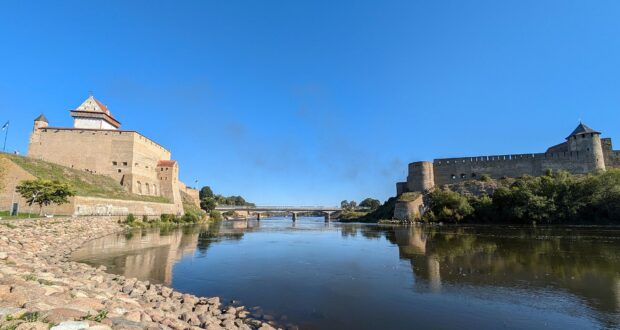
Image: Narva Castle in Estonia (left) and Ivangorod Fortress in Russia (right) (Source: Vicky Brock via CC BY-SA 2.0)