 Human Security Centre Human Rights and International Security Research
20 May, 2026
By Irena Baboi – Senior Fellow
On 12 April, Viktor Orbán’s sixteen-year reign over Hungary came to an end as he conceded defeat to challenger Péter Magyar in the country’s historic parliamentary election. Magyar and his Tisza party won 141 seats in Hungary’s 199-seat parliament, a supermajority that grants the incoming prime minister wide powers to reform Hungary. The outcome of this historic election marks a major turning point for Hungary, one that is likely to redefine not only the country’s institutions, but also its relations with the European Union, Russia, the United States, Ukraine and other Central and Eastern European nations. Magyar’s landslide win has significant implications both internally and internationally – and offers important lessons for other opposition movements looking to end the corrupt and illiberal rule in their own countries.
After four consecutive wins for Viktor Orbán’s Fidesz party – including the one four years ago, when opposition parties were expected to perform well by forming a common front against them – uncertainty, cautious optimism and a “hope for the best, but be prepared for the worst” atmosphere characterised the months leading up to Hungary’s historic election. While many independent polls showed Péter Magyar’s right-leaning Tisza party comfortably ahead of incumbent Viktor Orbán’s nationalist Fidesz, it was not clear if Tisza would secure a two-thirds majority in the country’s parliament. Mass demonstrations on both sides characterised the pre-election campaign, highlighting the deep political divide in Hungary. The system built in the last decade and a half allowed the incumbent to influence elections in his favour, and gave his party an entrenched advantage. The Fidesz government’s vision of an illiberal democracy – of which Orbán’s Hungary is often seen as the pioneer – translated into the erosion of judicial independence, the establishment of state-controlled media outlets, and the manipulation of the political narrative to a degree not seen before in a modern European democratic society. In his sixteen years as prime minister, Orbán carefully constructed a Fidesz-friendly election framework, and retained complete command over the rules that govern the Hungarian elections.
Following his 2010 win of Hungary’s last free and fair election, Viktor Orbán began laying the foundations for consolidating control over the country’s independent institutions and keeping himself in power. The size of the Hungarian parliament was reduced from 386 to 199 seats, out of which 106 became elected in single-member constituencies and 93 by proportional representation. The weight of single-member constituencies was also increased, with the share of MPs elected in constituencies rising from 46% to 53%, which strengthened the winner-take-all element of the system. More importantly, constituency boundaries were radically redrawn. As a result, opposition-leaning areas were concentrated into larger constituencies, while Fidesz-leaning areas were split into several districts, thus reducing the number of seats unfavourable to the ruling party. The Fidesz government also abolished the traditional two-round system – in which a runoff was held between the top two candidates if no-one achieved a majority –, extended voting rights to ethnic Hungarians living in neighbouring countries, legalised “voter tourism” – whereby Hungarians are allowed to register to vote anywhere in the country, even if they do not live there –, relaxed party registration requirements, and tightened the requirements for parties to stand in elections. In case all these changes failed to guarantee them the desired outcome, Orbán and his Fidesz party have also been accused of voter intimidation and outright vote-buying, with reports of Hungarians being offered money, potatoes, meat and other goods in exchange for their support.
Orbán’s Fidesz government also controlled much of Hungary’s media, with the majority of formerly independent news outlets now owned by his business allies. For many Hungarian citizens, especially those in rural districts, the only election narratives and campaign messages they saw or heard were state propaganda, with very little information from the opposition reaching them via the traditional media outlets. For eighteen months, challenger Péter Magyar was effectively barred from appearing on state media, while the government’s propaganda machine portrayed him as a reckless enemy of the peace, intent on involving Hungary in the war on neighbouring Ukraine. According to the Fidesz-controlled media, Magyar winning the election would immediately be followed by Hungarian men being conscripted, the economy collapsing, and a third world war erupting.
Internationally, Orbán was friends with both Russia’s Vladimir Putin and the United States’ Donald Trump, and could therefore count on both Moscow and Washington for political support. Assistance from Russia consisted of open expressions of sympathy, combined with intelligence activity, cyberattacks and the spread of pro-Russian narratives in the media and on social networks. On his side, United States President Donald Trump gave Orbán five public endorsements in the last six months, and vowed that Washington would provide Hungary with economic support if Fidesz was re-elected. On 7 April, United States Vice President JD Vance visited Orbán in Budapest to support his re-election bid, and accused the European Union of interfering in the vote to remove him from power. This foreign support from both the East and the West ultimately proved to be a double-edged sword – it reinforced Orbán’s image as a global player, but alienated voters averse to foreign interference in their domestic affairs.
For more than a decade and a half, Orbán fuelled fears and campaigned against those he described as the enemies of Hungary: liberals, the free media, universities, migrants, minorities and, most recently, the European Union and Ukraine. In the run-up to the election, Orbán and his team claimed that if Fidesz lost, Hungary will face war, mobilisation on the Ukrainian front, and enslavement and mass impoverishment as a result of tax increases from the European Union. Like every good autocrat, the outgoing Hungarian prime minister presented himself as the only guarantor of stability, peace and national sovereignty, and the protector of traditional values in a decadent world. Suggesting that the very survival of the Hungarian nation is at stake, Orbán portrayed himself as the only one who can save Hungary and its people from evil, and protect them from the threat of destruction at the hands of the country’s enemies.
In Hungary’s 2022 election, which took place only months after Russia’s war against Ukraine started, Orbán’s rhetoric worked to attract voters. In 2026, however, in the face of high inflation, worsening public services, growing corruption and rule of law backsliding, the people of Hungary were less concerned about being drawn into the Ukrainian war as fighters and more concerned about being able to afford their daily necessities. The outcome of the April vote also reflects the Hungarian people’s growing frustration with the endemic corruption in their country, and a political elite that has only grown richer since securing power. In 2025, Transparency International ranked Hungary as the most corrupt member state of the European Union for the fourth year running, reflecting the government’s continued failure to remedy rule of law deficiencies and curb systemic corruption. In recent years in particular, the Fidesz government’s centrally orchestrated system of channelling public money into private pockets – known as the National System of Cooperation, or NER in Hungarian – has cost Hungary €19 billion (approximately £16.5 billion) worth of EU funds, and caused it to become one of the poorest members of the European Union. Meanwhile, Orbán’s son-in-law and childhood friend have become Hungary’s wealthiest men by being consistently awarded the highest-value public contracts, and the outgoing prime minister’s 85-year old father – who is widely considered merely Viktor Orbán’s frontman – owns several building material companies, as well as the historic Hatvanpuszta estate, which was rebuilt into a luxurious manor worth hundreds of millions of dollars. As Transparency International notes, “the main reason for Hungary’s poor economic performance is an autocratic government that has subordinated its economic policy to systemic corruption and the organized theft of public funds, undermining fair competition”.
With crises affecting the Hungarian economy, as well as the education and healthcare systems, the Hungarian people wanted concrete solutions to the country’s problems – which Orbán’s challenger promised to provide during his pre-election campaign. For two years, Magyar visited villages, town squares and cities, venturing into Fidesz strongholds and rallying Hungarians who had had enough of the endemic corruption and cronyism that had come to define Orbán’s Hungary. The key to Tisza’s success and what set it apart from other opposition movements was also their approach to political engagement. Bypassing the state-controlled media that had been used to manipulate public opinion for years, Magyar and his Tisza party connected directly with the people of Hungary through social media, and sought to mobilise Hungarians to take part in the political process and demand change. Throughout his campaign, Magyar promoted cooperation over conflict, and a vision that blended traditional values with forward-looking technologies and ways of doing politics.
Péter Magyar winning the Hungarian election can also be partly explained by his career path leading up to the election. The leader of Tisza was a member of Orbán’s Fidesz party for twenty years, and held various posts within the Ministry of Foreign Affairs, at Hungary’s Permanent Representation to the European Union, and in Prime Minister Orbán’s office. In 2024, however, Magyar severed ties with Fidesz and joined Tisza following corruption allegations at the highest levels of the government and a political crisis sparked by Orbán’s decision to grant a presidential pardon to a former deputy director who had been convicted for covering up his superior’s actions in a child sex abuse case in 2022. As such, Magyar can be considered less of a longstanding opponent of Fidesz, and more of a critic of what the party has become under Orbán’s rule. This is most evident in the fact that Magyar’s political platform mirrors that of Fidesz in 2010, with a political programme centred on the fight against corruption and cronyism. During the pre-election campaign, Magyar repeatedly accused Orbán of authoritarian leadership, corruption and a dangerous closeness to Russia, and promised to build a stronger economy that works for everyone, not just the elite few.
Magyar’s landslide victory is also the result of coordination and compromise on the part of an opposition that realised the importance of unity over ideology. Once it was clear that the incoming prime minister was a realistic challenger, opposition parties consolidated behind him, and set aside their political differences to present a unified electoral alternative. This is a valuable lesson for countries like Serbia and Georgia, where despite an impressive scale, organisation and perseverance on the part of the protest movements, the opposition forces have so far struggled to turn public discontent into an electoral win. In the absence of a unified opposition, willing to subordinate its internal divisions to a common objective, long-term leaders in illiberal democracies can easily maintain their firm grip on power. As Hungary shows, it is only when the opposition forces come together and adopt a common strategy that popular anger can be channelled to disrupt the status quo.
It is also important to remember that overthrowing the long-term leader in power is only the first step, and that the road to overhauling a corrupt and illiberal system is long and challenging. The new leadership needs to commit firmly to delivering much-needed reforms of the system, and act quickly and decisively once the election has been won. In his victory speech on election day, Magyar urged Orbán’s loyalists in state institutions – the head of the top court, the chief prosecutor, the head of the media authority and the chiefs of the audit and the economic competition offices – to resign. The prime minister-elect has also called on Hungarian President Tamás Sulyok to “immediately ask the winner to form a government and then leave office”. Among his first actions as prime minister, Magyar has said he will change the constitution and introduce a two terms limit, an amendment the incoming head of government argues will prevent Orbán from returning to power. The Tisza leader has also announced he will shut down all state-controlled media, join the European Public Prosecutor’s Office, and set up an “office for the restoration of national wealth”, which aims to recover state assets and put those who participated in corruption behind bars. Magyar has pledged to investigate how Orbán and his inner circle have grown so rich, and promised that his government will introduce sweeping anti-corruption reforms: “we will do everything to restore the rule of law, plural democracy, and the system of checks and balances”.
Externally, Magyar has said he will end Hungary’s reliance on Russian oil and gas by 2035, and urge Russia’s Vladimir Putin to “end the killing” in Ukraine. The incoming prime minister has also said he will strive to maintain good relations with the United States, and pledged to pursue cooperative relations with the European Union, while still defending Hungary’s national interests. On Ukraine, Magyar unblocked the €90 billion loan agreed by EU leaders that Orbán blocked earlier this year, but the new Hungarian prime minister has said he opposes sending Hungarian weapons or money to Ukraine, and he opposes fast-tracking Ukraine’s EU accession. As the new Hungarian government hopes to unlock around €17 billion (approximately £15 billion) in EU funds, time will tell if this will be Magyar’s long-term position on Ukraine, or if wanting to improve relations with Brussels means there is room for negotiation. Meanwhile, Magyar has vowed to put the issue of Ukraine’s EU accession to a referendum, and will likely continue to try to cater to the large anti-Ukrainian sentiment in Hungary in order to maintain public support. The incoming prime minister has also declared that a restoration of ethnic Hungarian minority rights will be an important precondition for rebuilding ties with Ukraine.
The new Hungarian prime minister also wants to strengthen relations with neighbouring and other Central European countries, especially Austria, building on strong economic links and their shared history. The Tisza leader told supporters that his first trips as prime minister will be to Warsaw and Vienna, and has proposed the creation of a Central European bloc, which would be achieved by merging the Visegrád Group — an informal alliance of Hungary, Poland, Czechia and Slovakia — with the Slavkov format, a cooperation framework involving Austria, Czechia and Slovakia. Magyar’s goal is to create a strong coalition led by like-minded right-wing leaders who share a cultural outlook, economic interests and conservative views on everything from migration to energy policy. If united, this coalition could present coordinated proposals and projects to obtain funding from Brussels – it could also act as a counterweight in the European Union to countries like France and Germany when it comes to voting on relevant issues.
After more than a decade and a half of Fidesz political domination, a strong need for change was evident. A record 79.5% of the Hungarian electorate voted in the country’s parliamentary election, the highest turnout in Hungary’s democratic history. Almost two-thirds of Hungarians under the age of thirty voted for Magyar, and crowds of young people flooded the streets of Budapest to celebrate the result. Despite reports before the election of plans to deploy trained thugs – including Russian-sourced ones – to disrupt the opposition in the event of a close or contested result, Viktor Orbán accepted that his sixteen-year rule has come to an end, and congratulated Magyar on winning the election before all votes had been counted. Shortly after the polls closed, Orbán declared that the result is “clear and painful”, and that Fidesz will continue to “serve Hungary” from the opposition. With such a high turnout, and many of Magyar’s supporters and voters out in the streets, Hungary’s long-reining prime minister had little choice but to accept that he has lost this war.
With Orbán no longer in power, both Russia’s Vladimir Putin and the United States’ Donald Trump lose their key ally in Europe, and the right-wing populist movement loses its main figurehead and most vocal disruptor. For nationalist leaders across Europe, Orbán’s defeat signifies the loss of an ally, one whose political tactics were seen as the blueprint to ensuring indefinite political success. For Moscow’s Vladimir Putin, the loss is even greater than this – the Russian president loses a key source of information at the heart of the European Union, one that was reportedly revealing details of EU sanctions talks, and had allegedly promised to share confidential EU documents with the Kremlin.
Brussels, on the other hand, has breathed a sigh of relief – European Commission President Ursula von der Leyen waited only seventeen minutes to congratulate Magyar on his win, and celebrate the regime change in Budapest. For the European Union, Orbán represented a challenge to its unity, and a constant roadblock to its ability to enforce its rules. While in power, the outgoing prime minister repeatedly used his veto to block critical European Union decisions – including financial support for Ukraine –, fuelled Euroscepticism, undermined the rule of law in Hungary, and resisted the adoption and implementation of EU legislation. With Orbán’s defeat, even if Hungary remains a conservative voice on issues from migration to enlargement, Budapest will most likely be a more open and constructive dialogue partner moving forward.
The Hungarian people, with their resilience and determination, proved to the world something that has not been entirely self-evident in the last few years: that autocrats can be brought down, and they can be brought down by peaceful and democratic means. The new Hungarian government now has a moral duty and the strongest mandate in the country’s history to improve the economy, reverse corruption, and restore democratic institutions and the rule of law. In a time when democratic principles are consistently being eroded, Hungary’s road to regime change is nothing short of remarkable – and should serve as a blueprint for democratic movements across the world.
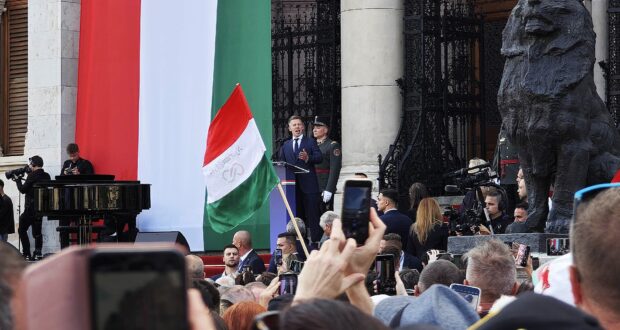
Image: Magyar’s speech on the occasion of the establishment of the National Assembly in the Kossuth Square on 9 May 2026 (Source: Elekes Andor via CC BY 4.0)