 Human Security Centre Human Rights and International Security Research
By Leo Gardner, Research Assistant
10 December, 2025
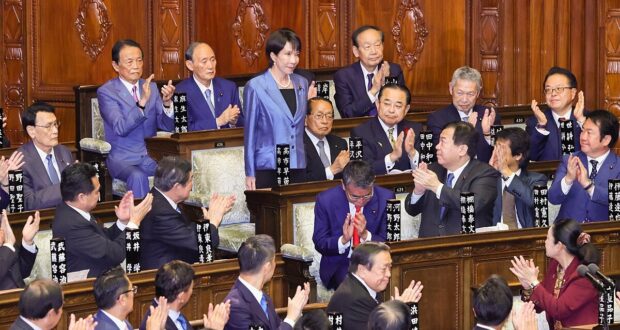
The Liberal Democratic Party (LDP) of Japan’s newly elected leader Sanae Takaichi was confirmed as Japan’s new Prime Minister on 21st October. Takaichi is also Japan’s first female prime minister in its history. Takaichi is renowned to fall much further on the right end of the political spectrum in comparison to her three immediate predecessors (Yoshihide Suga, Fumio Kishida and Shigeru Ishiba). This has been illustrated by her hard-line stances on immigration, historical education, same-sex marriage and foreign policy, particularly with regards to the People’s Republic of China (PRC) and the Taiwan Strait Crisis over the sovereignty of the Republic of China (ROC). Takaichi is one of former Prime Minister Shinzō Abe’s proteges, poised to continue Abe’s project of increasing Japan’s prominence in the international order.
Such observations have led some experts in the West to tentatively dub Takaichi a ‘Japanese Thatcher’. Takaichi is known to idolise Margaret Thatcher and derive much from inspiration from her. However, is this comparison an entirely accurate one, especially owing to the different traditions of conservatism in the UK and Japan? The different postwar trajectories in security policy of both states also mean this comparison is not the most accurate one, especially considering that mid-2020s Japan also faces very different economic and societal issues from those faced by the UK in the 1980s.
There are some notable similarities between the traditions of conservatism in the UK and Japan. Perhaps the most obvious one is the respect for monarchical tradition in both countries: this in turn constitutes much of their respective national identity and sense of historical continuity. Similarly, both states draw upon national traditions, heritage and state-specific institutions such as the Church of England being directed by the British monarch and the Japanese Emperor regarded as a symbol of state and unity of the Japanese people as head of the Shintō religion. As per the prewar Meiji Constitution, the Japanese Emperor was in fact accorded a sacred spiritual status. In addition, they show quite similar approaches to public policy and management: the tradition of neo-corporatism in the UK, whereby the public sector displays heavy reliance on the input and insight of the private sector, shows considerable overlap with the ‘iron triangle’ of politicians, businessmen, labour unions and bureaucrats in the Japanese policymaking world. While historically in the UK this was built on stronger, centralised labour unions able to negotiate with the government and employers on a national and sectoral basis, this was significantly altered by Takaichi’s idol Thatcher in the 1980s and New Labour in the 1990s and 2000s. Union mergers such as ‘Unite’ have not restored the bargaining power enjoyed by the unions prior to the Thatcher era, and it remains to be seen whether proposals grouped under the ‘New Deal for the Working People’ by the current Labour government will succeed in centralising the unions’ bargaining power and involvement in economic policy. As a result, nowadays it much more strongly aligns with the Japanese model as it is much less decentralised, with negotiations between government, unions and companies conducted on an individual firm-by-firm basis. In Japan’s case, it is very unlikely that the current system will change due to strong preferences for conformity and an overall aversion to drastic change at the societal, economic and political levels alike. Conservativism in both the UK and Japan also exhibit traits of paternalism, with the LDP employing state structures to grow and manage the national economy while the UK’s ‘One Nation’ conservative school relied on state intervention to ensure a degree of national cohesion. Moreover, conservatives in both the UK and Japan attach strong importance to security and defence, particularly in the context of the UK’s ‘special relationship’ with the US and the US-Japan Security Alliance.
However, the differences between these national conservative traditions are much more pronounced given the quite different historical trajectories specific to each state. This is especially so in the case of early Japanese conservatism emerging in the Meiji period of the 19th century as a reaction to Japan’s initial negative experiences in its first contact with the West for over two centuries, such as the ‘Unequal Treaties’ which contained favourable clauses for Western Powers and the Triple Intervention, as a result of which Japan was pressured by France, Prussia and Russia to return territories it had gained during the First Sino-Japanese War in 1895. On the other hand, British conservatism, influenced by thinkers such as Edmund Burke, emerged largely as a response to the French Revolution which in turn led to a re-evaluation of the relationship between religious institutions and the state, the status of citizenship and increased political participation across wider socio-economic groups. As a result of both the Meiji Period and its postwar restructuring, Japan also possesses a single, codified constitution akin to the US and France, unlike the UK. Japanese conservatism also displays considerable influence of Confucian traditions such as filial piety and emphasis on the group as opposed to the individual in the UK.
Takaichi’s path to the prime ministership was set back by the departure from the governing coalition of the Sōka Gakkai-affiliated Kōmeitō party, which advocates for Buddhist democracy and pacifism. However, Takaichi grasped victory by negotiating a coalition with the Japan Innovation Party (JIP), an Osaka-based populist party and relative newcomer to Japanese politics led by Osaka Prefecture governor Hirofumi Yoshimura. Yoshimura is a protégé of none other than Tōru Hashimoto, founder of the JIP, former governor of Osaka and also famous for being the son of a yakuza (Japanese mafia) member, his nationalistic rhetoric and revisionist interpretation of historical events such as the Rape of Nanking in addition to his eccentric personality. Yoshimura himself is also well renowned for cancelling Osaka City’s sister city relationship with San Francisco over a Chinese-American group’s plans for the installation of a statue commemorating ‘comfort women’ (ianfu) who were forced into sexual slavery by the Imperial Japanese armed forces during the Second World War. Whereas Kōmeitō was widely considered to fall firmly in the political centre in its policy outlook, JIP is very much located further to the political right. Now that Takaichi and Yoshimura’s respective parties have formed a coalition, we can expect a shift towards a more rapid and striking style of policymaking, particularly with regards to reform of the Japanese Constitution’s Article 9 which severely constrains Japan’s engagement in military activity. Furthermore, President of the United States (US) Donald Trump would not hesitate to support such moves, given his dedication to making NATO as well as ‘non-NATO Plus’ members such as South Korea and Australia contribute more to their own defence as opposed to relying on the US security umbrella that defined much of the Cold War global order and bipolarity with the Union of Soviet Socialist Republics (USSR).
Trump is known to reward NATO member-states and non-NATO allies alike for meeting or exceeding their defence spending expectations, and to punish those which fail to do so. A case in point dates back to Trump’s first term in 2019, when Poland was rewarded with an allocation of US military personnel previously stationed in Germany, which in turn had failed to meet its spending requirements. These developments point to significant inconsistencies and divisions within the European security architecture in the face of worsening relations with Russia following the 2014 annexation of Crimea and the 2015 intervention in the Syrian civil war. More recently, Trump suggested Spain’s expulsion from NATO for failing to fulfil its defence spending obligations in addition to US trade tariffs.
Takaichi has been heavily involved in bilateral and multilateral formats alike in recent days. Her first overseas trip to Kuala Lumpur saw her participate in the Association of Southeast Asian Nations (ASEAN) conference, followed promptly by her first bilateral summit with Philippine president Ferdinand Marcos Jr: Takaichi pledged greater maritime security cooperation and expansion of official development assistance (ODA). The Asia-Pacific Economic Cooperation (APEC) meeting in Gyeongju, South Korea also proved to be a prime opportunity for Takaichi to showcase her diplomatic capabilities. Preliminary discussions with South Korea’s President Lee Jae Myung appeared very promising, with Lee expressing optimism over future bilateral ties with Japan despite initial concerns over Takaichi’s hawkish views on historical issues leading to a deterioration instead. Takaichi also met with PRC premier Xi Jinping on the sidelines of the APEC summit, and whilst productive dialogue was conducted on issues ranging from territorial disputes, the safety of Japanese expatriates in the PRC and rare earths, this meeting appeared to achieve less than Takaichi’ meeting with Lee. Xi did not extend a congratulatory message to Takaichi upon her election, and so it is possible that the PRC is displaying caution over potential Japanese efforts to reverse South Korea’s nordpolitik with North Korea, by extension of which South Korea has since the 1990s improved ties with the PRC to the detriment of its relations with Japan and the ROC.
Takaichi then swiftly returned to Japan to meet with Trump. They proceeded to sign an agreement at Akasaka Palace on rare earths and a document on the consolidation of US-Japan relations, including a fresh pledge regarding this year’s 15% tariff agreement. Takaichi also reportedly notified Trump of her intentions to nominate him for the Nobel Peace Prize. Trump and Takaichi also gave speeches aboard the USS George Washington, making a commitment to the ‘Free and Open Indo-Pacific’ as the basis of strategic US-Japan cooperation.
Takaichi’s stances will also likely lead to a new wave of cultural contestation and inter-ethnic tensions within Japan. With its homogenous population and foreigners accounting for 3% of Japan’s population, it has been suggested that Takaichi’s election will lead to the possible disenfranchisement and alienation of Japan’s Zainichi Korean and Chinese communities in particular. This in turn would reflect an increasingly populist LDP as it pursues short-term gains despite longer-term economic impact from protectionist measures such as tariffs and barriers to foreign investment as typified by the majority of populist-driven strategies. In contemporary politics, populist sentiment is nothing to be underestimated in terms of its strength and traction. Widely unexpected events such as the UK’s 2016 referendum on its membership of the European Union (EU) resulting in the majority voting ‘leave’ in addition to the success of anti-establishment parties ranging from Syriza in Greece to La Libertad Avanza in Argentina in national elections all serve as examples of populism-driven political decisions. They also continue to demonstrate that while being broad in its very definition, populism very effectively feeds from dissatisfaction with increasing interconnectedness and what is perceived to be the negative intrusion of processes such as globalisation, offering simple solutions to complex problems and employing appeals to emotion. Disaffected and dissatisfied individuals eligible to vote are in turn easily mobilised by such movements. This will not necessarily lead to violent, drastic events such as revolts or civil wars owing to the relatively stable nature of Japanese society and political thought. However, whichever changes occur as a result of the Takaichi administration’s policymaking will manifest over a protracted period of time and will most likely lead to structural changes such as constitutional reform which would subsequently advance Japan’s remilitarisation. Whether this is accepted by its immediate neighbours and the rest of the international community remains a separate question which will only be definitively answered when this occurs.
Image: Takaichi is elected Prime Minister by the Diet, 21 October 2025 (Source: created by HSC via processing (cropping) image “Nomination of the Prime Minister”, Prime Minister’s Office website via Public Data License (Ver.1.0))