 Human Security Centre Human Rights and International Security Research
By Luke Austin Research Assistant
28 January, 2026
Despite being subjected to international sanctions following its February 2022 invasion of Ukraine, Russia continues to expand its energy export market and has for the most part remained a major global supplier of hydrocarbons. Whilst it has lost its European market in the past four years, it has made inroads into the Asian and African energy markets. For example, earlier this year the Russian and Chinese governments signed a preliminary agreement on the Power of Siberia 2 (PoS-2), a 2,600-kilometer pipeline to carry gas supplies of up to 50 billion cubic meters (bcm) that could potentially provide one fifth of China’s required natural gas in 2030. Furthermore, Russian oil sales in Africa grew by 144% in 2023, with Morocco, Egypt and Tunisia representing the three most prolific purchasers.
Russia’s Sakhalin-II project has been used to supply around 10% of Japan’s liquefied natural gas (LNG). In contrast to Western states’ extensive sanctions against Russian energy infrastructure projects such as Nord Stream in Europe, the US has very recently extended Sakhalin-II’s import permit, allowing it to continue LNG supplies to Japan. Sakhalin-II traces its earliest foundations back to 1994, when the Sakhalin Energy consortium comprising Marathon, McDermott, Mitsui, Royal Dutch/Shell and Mitsubishi signed an agreement for the development of oil and gas deposits near Sakhalin’s coast. For the previous 20 years beforehand, foreign (predominantly Japanese) firms had attempted to develop these deposits but with limited success due to a mixture of difficult operating conditions, lack of financing and political tensions. After the project’s final approval was granted in 2003, financing rapidly increased in 2005 and 2006 alongside opposition from environmental and indigenous activist groups. The Natural Resources Ministry’s watchdog conducted an environmental audit in 2006, leading to demands of $30 billion in compensation from Sakhalin Energy. It was taken over in 2006 by Russian energy giant Gazprom from Shell after the former paid £3.8 billion to acquire a stake of 50% plus one share, with the latter’s share halving to 27.5%. By 2009, it had transpired that the environmental audit and the publication of its findings constituted a pretextual move towards the Russian government acquiring majority ownership of the project under the guise of environmental protection. Sakhalin-II’s LNG operations also commenced that year. In 2024, Gazprom acquired Shell’s shares in the project following Shell’s withdrawal due to the invasion of Ukraine.
The US government extended a sanctions waiver concerning operations involving Sakhalin-II in mid-December until June 2026. Russia’s Arctic LNG project, in contrast, has been targeted with sanctions. There are several possible factors influencing this decision. These range from US President Donald Trump’s willingness to accommodate President of the Russian Federation Vladimir Putin at the expense of security and stability for European partners (especially Ukraine) and perhaps, most likely, a quiet acknowledgement of Japan’s precarious energy security situation. Being notoriously lacking in terms of natural resources, it may signal an attempt to delineate between security and economic policy as Germany and several other NATO/EU member-states attempted to do prior to 2022.
However, such an approach poses extensive risks of its own to not only Japan, but also the rest of the region. In failing to take action, new Japanese Prime Minister Sanae Takaichi might be undermining the approach sought by her mentor the late Shinzo Abe in jeopardising Japan’s longer-term energy security for short-term gains related to cost and immediate availability. This is also compounded by the fact that the issue over Sakhalin-II is inherently tied to another issue which has definitively shaped the negative trajectory of Russo-Japanese relations: the Kuril Islands issue over four islands under Japanese control prior to 1945 and their annexation by the Soviet Union. Whilst Russia has mobilised economic resources in Sakhalin and the Kurils as leverage, Japan’s continued claims to the disputed territory add a further layer of complexity. Russia’s own position on the issue appears uncompromising according to Russian commentators: its control over the Kurils is considered a matter of national security and an integral part of its military presence in the Pacific. The Russo-Ukrainian War has hardened these positions over the past four years, with Russian policies ranging from the prohibition of maps not designating the Kurils as Russian territory to the suspension of a fishing agreement which had previously permitted Japanese fishermen to operate in the southernmost Kurils in attempt to punish Japan for its support to Ukraine.
It has also been suggested that Japan’s complete withdrawal from the Sakhalin-II project would lead to cheaper energy supplies to China and India, which has already occurred as mirrored in a 10% increase in Chinese shares in Sakhalin-II exports between 2020 and 2025. Russia’s increased presence in the Chinese energy market has also been facilitated by land-based projects such as the Power of Siberia 2 pipeline, which is expected to deliver 50 bcm of natural gas annually. Japan weaning itself off Russian LNG via Sakhalin-II is therefore a delicate balancing act, with complete withdrawal meaning Russia’s extended penetration of the Chinese and Indian energy markets. However, this tendency is nothing out of the ordinary as Russia, India and China are original members of BRICS: a loose multilateral format which was built on a relatively weak foundation driven primarily by short-term economic trade that seems more favourable than it actually is and self-interest rather than long-term cooperation and security cooperation. Its feasibility is further threatened by expansion of membership to geopolitical rivals such as Saudi Arabia and Iran. Russia and China each possess divergent perspectives on the evolution of the Shanghai Cooperation Organisation (SCO): China prefers to retain the SCO as an economic bloc, whilst Russia has historically emphasised its importance as a security-based alliance. India, despite inheriting positive relations with Russia from its Cold War partnership with the Union of Soviet Socialist Republics (USSR), remains a key member of the Quadrilateral Security Dialogue (Quad) alongside the US, Japan and Australia and has also been engaged in intense geopolitical rivalry with China for almost eight decades. The longer-term sustainability of India’s relationship with Russia has therefore been called into question, particularly given Prime Minister Modi’s close rapport with Trump and increased tensions with Pakistan. Unlike China, India’s imports of Russian hydrocarbons have actually decreased sharply towards late 2025: whilst the expansion of EU sanctions and increase of US import tariffs on India have been given as the prime reason, it has also been suggested that the Indian government has prioritised reaching a new trade agreement with the US in addition to alleviating the sanctions enacted by the second Trump administration against India last year. It is also likely that many at the policymaking level in India have observed the examples of Japan and CEE states such as Poland and Germany in appreciating the importance of diversifying one’s energy mix as opposed to relying heavily on one major supplier: particularly one which continues to undermine a rules-based international order through military aggression and propagate a revisionist interpretation of political history in an attempt to justify its behaviour.
It is also worth noting that Takaichi is subject to sanctions by Russia, including being one of 63 Japanese citizens barred from entering Russia on 4 May 2022 due to contributing to a “an unprecedented anti-Russian campaign, allowing unacceptable rhetoric against the Russian Federation, including slander and direct threats” as alleged by Russia’s Ministry of Foreign Affairs MFA). With Takaichi and many other Japanese politicians unable to personally visit Russia, Japanese lawmaker Muneo Suzuki has made the most recent high-profile visit by a Japanese figure to Russia. This visit in late December also reflected how deeply entrenched the Kuril Islands issue is in Japanese domestic politics, with Suzuki making a request for Japanese citizens to be able to visit the Kurils: the Kuril Islands issue is a subject of much controversy based on historical sensitivity due to the presence of Japanese graves and cemeteries on the islands in addition to the wartime internment of over 500,000 Japanese in Siberian camps, where the death rate was notoriously high.
One way in which Japan could improve its energy security is by increasing its share of LNG imports from the US. This is a step which has allowed numerous CEE states such as Poland and the Baltic states to reduce their energy dependence on Russia. The Japanese power-producing giant JERA has already confirmed that it will treble such imports by 2030. Whilst this will inevitably be financially costlier, the experience of late-adapting Russian energy importers such as Germany and Austria demonstrates that it is often worth paying more for the added reliability of alternative energy supplies to those originating from Russia. A second option is the development of increased civil nuclear capabilities: this would, however, face severe constraints based on historical experiences ranging from the 2011 Fukushima disaster to a widespread conflation of nuclear power for civilian as opposed to military purposes due to Japan’s unique status as the only state to have been targeted with atomic ordinance against the cities of Hiroshima and Nagasaki at the end of the Second World War in 1945. This aversion might be necessary to overcome if natural resource-poor Japan intends to maintain a secure supply of energy, avoid energy shocks and meet UN net zero carbon emission targets by 2050. It was, after all, the oil shocks of the 1970s following the 1973 Yom Kippur War and 1979 Iranian Revolution that spelt the demise of Japan’s Kōdo keizai seichōki (period of high-rate economic growth) that is synonymous with what is referred to as its “postwar economic miracle” in the West.
Much insight can be gained from much of Central and Eastern Europe (CEE) before February 2022. Between the 1990s and 2010s, these states depended on Russian energy imports either entirely or heavily. In recent years, many of these states, particularly those which have historically experienced more negative relations with Russia such as Poland and the Baltic states, have massively reduced Russian imports as part of their respective energy mix. However, Hungary has in fact increased its energy imports from Russia citing cost-related reasons, while Slovakia continues to be reliant on Russia for its energy supplies despite a slight reduction in imports since 2022. The opportunity for both Hungary and Slovakia to secure imports via LNG terminals situated within Germany, Greece, Italy or Poland strongly implies that their respective energy policies are directed by pro-Russian sentiment in Hungary and a desire to preserve low energy costs for domestic energy consumers in Slovakia, where pro-Russian sentiment is comparatively high for an EU and NATO member-state but still lower than that displayed in Hungary. While Slovakia and Hungary are notable exceptions, the remainder of the CEE states go on to show that it is possible to reduce if not eliminate energy dependency on Russia: the short-term costs may appear large, but the longer-term situation appears to constitute the ends which justify the means.
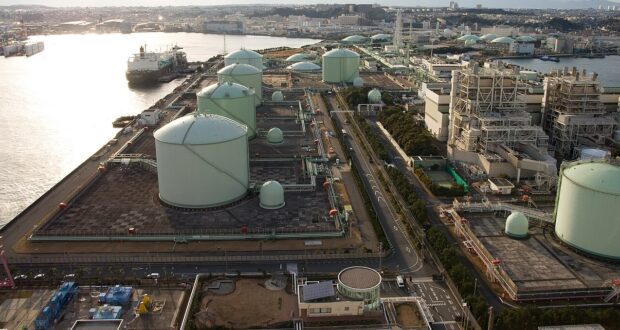
Image: Negishi liquefied natural gas terminals terminal, Yokohama, Japan (cropped) (Source: Σ64 via CC BY-SA 3.0)