 Human Security Centre Human Rights and International Security Research
By Oliver Hegglin, Junior Fellow
27 November, 2026
The 2026 USA-Israel – Iran war plunged the Persian Gulf into a state of conflict that would result in global financial disruptions. The economic safety of Gulf states was shattered, tourism dropped, and the world’s largest supply of oil and gas was disrupted as a result of damaged energy infrastructure and the closure of the Strait of Hormuz. While no state was unaffected despite assurances that their territory could not be used for offensive operations, there was also no unanimous response despite warnings to Tehran not to target Gulf states. With diverging interests emerging, the result was unilateral actions and the establishment of blocs that will drive the future of Gulf relations with Iran, the United States and Israel.
The war itself began on February 28, when combined United States and Israeli efforts launched strikes on Iranian leadership, nuclear and military sites. Iran responded by closing the Strait of Hormuz and by targeting Gulf states in retaliation in declared self-defense, hitting not only American military installations, but also energy facilities, airports, hotels, and other civilian infrastructure. Iran claimed complicity and deemed such facilities to be legitimate targets, warning Gulf states of the cost of hosting Western military assets.
The Gulf Cooperation Council
Following the start of the war, the Gulf Cooperation Council (GCC), a regional intergovernmental political and economic body comprised of Bahrain, Kuwait, Oman, Qatar, Saudi Arabia, and the United Arab Emirates, convened an emergency session in response to hostilities. Collective condemnations, condemning Iran’s attacks against their member states as “serious violation[s] of…sovereignty, good unneighborly principles, and a clear breach of international law and the UN Charter”. Council members reaffirmed they would “take all necessary measures to defend their security and stability.” How they would do this would prove to differ from state to state.
By the time of the meeting, Iran had targeted the six states by launching over four thousand projectiles, many of which were intercepted, despite years of rapprochement and normalization. Despite this onslaught, the GCC does not have a platform for shared authority during crises and systematic intelligence sharing. Rarely has it acted cohesively, leaving its members questioning if to remain uninvolved while absorbing attacks or to retaliate in their own right.
The result was the six GCC partners responding individually, showing gaps in regional unity and highlighting existing tensions and diverging interests among themselves. What they all do have in common, however, is the hosting of American military installations, of which 19 exist across the region. With deaths and injuries, reactions ranged from increased diplomatic efforts at resolving the conflict to hawkish attempts to push the US in continuing strikes against Iran.
United Arab Emirates
Perhaps the most hawkish of the Gulf States, the United Arab Emirates (UAE) is said to have pushed the US administration for a ground invasion of Iran following the highest volume of missile and drone attacks across its territory, including against civilian infrastructure. Bahrain and Kuwait are believed to have supported this posture and Iran has likewise threatened invasion of the UAE and Bahrain in response. The UAE holds the position that more damage should have been inflicted against Iran prior to any ceasefire and has launched airstrikes of its own in coordination with the US and Israel, making them more aligned with the USA and Israel than any other Gulf state. It also hosts the United States’ 380th Air Expeditionary Wing on the Al Dhafra Air Base.
The UAE has asserted itself as an independent actor internationally and maintains not just diplomatic ties with Israel, but also military, with possible intelligence sharing and cooperation in the cyber-realm. It has pledged to “double-down” on its support with the USA and is believed to have received Israeli Iron Dome air defense systems with supporting personnel. The UAE and Israel are also believed to have established a joint fund to develop and acquire new weapons. These close Israeli ties are unconventional for a Gulf state and are arguably the closest of any Arab state. The Emirates and Bahrain stand out in that they have formal diplomatic relations with Israel following the 2020 Abraham Accords, to the distrust of other regional neighbors. Media also alludes to visits by Israeli Prime Minister Benjamin Netanyahu and the heads of Israel’s Mossad and Shin Bet to the Emirates during the war to coordinate bi-lateral efforts, indicative of a long-term strategic partnership.
Despite the Emirates’ strong response, it does maintain diplomatic ties with Iran, restored in 2022, and has attempted to reduce tensions. After all, prolonged fighting risks Emirati energy facilities and damaging the reputation of cities like Abu Dhabi and Dubai as financial hubs. Its retaliatory strikes can therefore be seen as a show of force against Iran that it demands to be accepted as a strong and competent regional actor. However, for diplomacy to occur, Irani attacks would have to stop first, calling them a “flagrant violation of sovereignty”. With Irani strikes following years of diplomatic efforts, the Emirates have likely also determined that diplomacy has limited value and that it is strategically important to strengthen ties with the USA and Israel.
Both the Emirates and Bahrain perceive Iran as a persistent threat to Gulf security and any degradation in power is a strategic advantage. Coming out of this conflict, the Emirates appear to be attempting to strengthen existing, and establishing new, partnerships for the future geopolitical reality in the region.
Kingdom of Bahrain
Bahrain is the smallest of the Gulf states, who’s capital Manama is home to the US Navy’s Fifth Fleet, operating in the Persian Gulf, Red Sea, Arabian Sea, and parts of the Indian Ocean. The small country, like the UAE, also views Israel as a key security partner against Iran. This is likely why it was one of the main Irani targets. Both the Fifth Fleet and civilian infrastructure were targeted by Iran.
State of Kuwait
Irani attacks against Kuwait have hit the US’s Ali Al-Salem air base, affecting the international airport and residential buildings alike. The country also hosts US Army Camp Arifjan, which holds stocks of equipment and supplies which can be distributed via the airlift focus of the Ali Al-Salem.
Kuwait is under growing Emirati influence. Following Iranian aggression, it may pursue a path of normalization with Israel, leaving behind its passive foreign policy after the 1990 Iraq invasion. Iran’s attacks have gone as far as to hit water desalination plants, as if pushing Kuwait to take a more proactive stance in regional geopolitics.
Kingdom of Saudi Arabia
In contrast to the UAE, Saudi Arabia pivoted from initially launching retaliatory strikes against Iran after being hit itself, to supporting a diplomatic solution. The two are now moving in diverging directions, with Saudi Arabia calling the UAE’s growing partnership with Israel a threat. Saudi Arabia has also gone as far as to claim that the Emirati attacks against Iran were increasing the risk of additional strikes from Iran, risking spikes in oil prices that could affect the global energy market, keeping in mind that the Kingdom’s economy is highly dependent on oil and gas. The two heads of state, Emirati President Sheikh Mohamed bin Zayer and Saudi Crown Prince Mohammed bin Salman, also appear to have had a falling out after the Saudis refused to participate in strikes against Iran. In contrast, the Kingdom’s efforts have been focused on a diplomatic resolution, with relations with the Islamic Republic having been restored in 2023. The Saudi-led side of the divide opposite the UAE is supported by Qatar and Oman, whereas Bahrain finds itself aligned more closely with the Emirates and its relationship with Israel.
Despite this public position by the Kingdom, reporting has emerged that Saudi officials have remained in close communication with their American counterparts, encouraging further attacks to weaken Iran to the benefit of Saudi Arabia, Iran’s regional counterweight, something it denies. In all likelihood, as is the case with all Gulf states, Saudi Arabia is balancing public diplomacy while pursuing more strong-armed options to assert its interests, which include ending Iran’s nuclear program, its ballistic missile capabilities, support for proxy groups, and its ability to unilaterally close the Strait of Hormuz. It may be Saudi Arabia does not have the capabilities to be more assertive in its interest to end the Irani regime, however its economy has suffered, and its priorities undoubtedly lie in its economic goals laid out in its Vision 2030 agenda to diversify its economy, for which regional stability is a foundation. The war has forced the Kingdom to divert oil exports to the Red Sea.
State of Qatar
Since at least Israel’s strike against Hamas leadership in Doha in September 2025, Qatar has viewed Israel as a regional destabilizer, similar to Saudi Arabia and Oman, and has pursued a restrained, non-aggression path to resolving tensions with Iran. It maintains channels with Iran, also sharing a large natural gas field, and holds a position as a mediator within the region between Israel and Hamas, and between Iran and the United States.
Qatar hosts the Al Udeid air base, the largest American facility in the Gulf, hosting US Central Command, combat aircraft, and airlift, refueling, intelligence, surveillance, reconnaissance, and evacuation capabilities. Yet despite suffering attacks by Iran, also in residential areas, Qatar has moved to negotiate a diplomatic solution, which it successfully did, playing a key role in the Pakistani-mediated April ceasefire which lasted until July. Statements by its foreign minister echo the concerns of its neighbors, highlighting that the region must not “be dragged into a direct confrontation with Iran”.
Sultanate of Oman
Oman stands out as the only Gulf state to explicitly have condemned the war against Iran, with whom it has historically maintained close ties. It also maintains good ties with the US, pushing for de-escalation, and has also acted as a mediator between Washington and Tehran in past decades. The Sultanate’s priorities have rested in safe and uninterrupted shipping through the Strait of Hormuz, for which it likely realizes that proximity to Iran requires cooperation as a pre-requisite in the future. However purposeful Irani attacks, despite a visit by Iran’s foreign minister to Muscat, may be indicative of Tehran’s intent for sole control of the Strait. This shows that despite good relations with Iran, the neighbor across the Persian Gulf may be an unpredictable actor in the future.
Emerging Blocs
Whether willing or not, the Gulf states are being forced to come to terms with the geopolitical reality that bi-lateral United States defensive agreements, long believed to serve as a deterrent and safeguard against Iran, have instead made them targets. In their response to retaliatory attacks by Iran, each has had to decide how to protect themselves and how to orient themselves in the new geopolitical reality. As the war showed, the GCC’s defensive mechanisms, which should include shared early warning, common stockpiles, joint training, and a crisis mechanism, were left unused, and exposed its member states’ fragmented response.
Emerging are what can be seen to be two blocs to balance Iran’s existing influence in the region, with arms extending to proxy groups operating in Yemen, Lebanon, Iraq, and the Palestinian Territories. One is the Emirati-Israeli cooperative with Bahrain and possibly future Kuwaiti alignment, while the other is the Saudi-diplomatic bloc, with mediators Qatar and Oman focusing on financial stabilization. Important to note that this does not mean Saudi Arabia and Iran are partners. On the contrary, the geographic and strategic reality is that Iran remains a formidable foe, albeit weakened, in the Gulf, resulting in a partial détente with Iran. All Gulf states are thus left to balance short-term responses to Irani threats and attacks with long-term stability and co-existence to preserve shared economic interests.
These blocs are not formal allegiances, as each country continues to follow its own policies, but instead alignment based on common predicaments rather than a united strategy in navigating a highly volatile environment. Gulf neutrality in greater US-Iran affairs is no longer an option, and in reassessing how to best protect themselves due to the wide capability gap vis-à-vis Iran, Gulf countries have found a need to strengthen their own defensive capabilities while balancing political, economic and military interests with the United States. With few alternatives, American military might remains the region’s primary security guarantor, though the emergence of partnership pluralism in the form of these blocs appears to have been a natural step for states to take. What remains to be seen is if this form of cooperation can endure the next crisis.
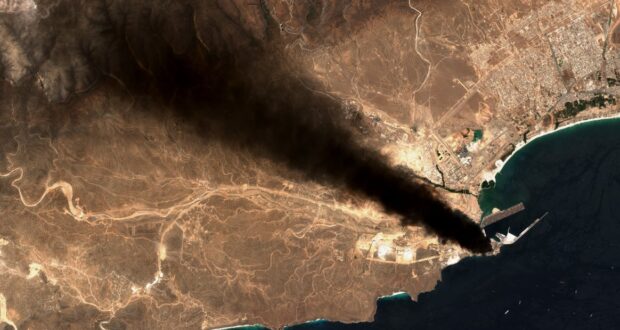
Image: Satellite imagery captured on March 13, 2026 of black smoke rising from Salalah port (Source: Contains modified Copernicus Sentinel data 2026) (The use of Copernicus Sentinel Data is regulated under EU law (Commission Delegated Regulation (EU) No 1159/2013 and Regulation (EU) No 377/2014).