 Human Security Centre Human Rights and International Security Research
By Oliver Hegglin, Junior Fellow
20 January, 2026
A series of existing international agreements is intended to guide human activity in outer space. However, this legal framework is facing difficulties in today’s geopolitical climate. While space has become an increasingly critical domain for commercial, civil and strategic interests, international law and established norms being challenged.
Space is no longer a peaceful “global common”, and is an ever more contested, congested and competitive geopolitical environment, on which activity planet-side relies on more and more and has attracted the interest of great powers. To safeguard national security and orbital infrastructure, and find ways to prevent disruption of such assets, civilian and military leaders around the planet are calling for an increase of sovereign space capabilities, with many countries shifting their orbital focus to emphasize that future conflicts will extend into space.
Though the 1967 Outer Space Treaty (OST) remains the foundation for extra-terrestrial activity, there is a lack of wider international regulation regulating military posture and actions in space. Consequently, there is a risk of a “space-based arms race” over orbital zones and extraterrestrial resources should this not be addressed.
A New Dimension in Warfare
Space programs were rapidly developed during the Cold War for security purposes, and a strategic competition over space ensued. Following a post-Cold War lull, more aggressive approaches to space-based assets have returned. Anti-satellite missile tests by the major powers have been the most obvious, but less high-profile incidents such as Russia’s initiation of the 2022 invasion of Ukraine with a cyberattack targeting modems linked to communications satellites used in contemporary warfare for movements, communications, detection, surveillance, and targeting have had operational consequences.
Actors who are able to assert control over space have the ability to shape geopolitical developments on the surface. Should any one state achieve military control over near-Earth space, critical for the establishment of global hegemony, it would possess command over Earth’s proverbial ‘high-ground’. States seeking to occupy this role and actively participate in space governance require unique technological capabilities and must hold influential positions in multilateral forums. Non-spacefaring states are being pressured to recognize the need to align with a space power to ensure their own security.
Militarizing and Weaponizing Space
The militarization of space, which is the usage of space-based assets for command, control, communication, surveillance, and reconnaissance activities, is a subject of debate. These orbital assets assist planet-side operations by capitalizing on space-based positioning. In contrast, space weaponization refers to the development, deployment, and use of weapons, including those based in space or on heavenly bodies, or that transit space, or that pose a direct threat to space-based infrastructure. In other words, whereas militarized space assists operations on Earth, weaponized space turns space into the battleground.
Three states currently have the ability to deploy and operate fully autonomously in space (primary space powers): the United States, Russia and China, with others having to cooperate with like-minded partners (secondary space powers). And of these, only the USA and China operate independent branches of their militaries dedicated to space: the United States Space Force, and the People’s Liberation Army Aerospace Force, with Russia operating its space program within the Russian Aerospace Forces. Secondary space powers, such as France, Germany, Italy, Spain, the United Kingdom, Japan, and Israel, have military space programs within their existing armed forces structure and are developing counterspace technologies based on their civilian experience.
None of the European countries are believed to aspire to full-spectrum space militarization, as they have access to American systems and capabilities through NATO membership. This makes the United States the pre-eminent Western space power. Already in 2017, the US’ National Security Strategy explicitly identified enhancing space power capabilities as vital to national interest and officials have argued that it will take an integrated multinational effort and the support of its allies to protect systems that enable modern terrestrial life and establish norms for space behavior – a role NATO is uniquely positioned to fulfill. NATO recognizes the strategic significance of space and in 2019 declared space an operational domain, confirmed in 2021 that Article 5 can be applied in space, and published its intent to integrate space into its core functions in 2022.
Space Eagle
With the US leading a NATO-centric approach to space security, effective integration of the 32 alliance members requires assessing the capabilities of each to prevent duplication. Through events such as the annual Space Chiefs Forums of like-minded states, military leaders from the US and multiple partners, including non-NATO, meet to discuss and find ways to cooperate across a range of missions. The 2024 joint statement by 18 partner states exemplifies this by reaffirming their combined efforts to deter “ambiguous, unfriendly, or hostile activities” and to continue to promote “mutually agreed norms and responsible behavior” in space.
In this way, the US has been showing leadership in space by assembling partners and determining which niche abilities each has and in what fields specific partners can grow their competencies. The US’ Space Command, SPACECOM, strives to host individuals from partner states at its Peterson Air Force Base headquarters to facilitate this cooperation. One such initiative is SPACECOM’s Multinational Force Operation Olympic Defender, aimed at strengthening international cooperation in space defense. It has grown since its inception in 2013 with France and Germany joining the Five-Eyes in 2024. Such efforts emphasize the US’ push to strengthen interoperable international partnerships.
A Great Wall in Space and Russian Ambitions
The United States views Russia, and especially China, as its primary competitors in space. Its intelligence community has previously designated China as the ‘top threat’ to US technological competitiveness, and warned that both adversaries are developing counterspace weapons with the intent to target US and allied satellites. Both are rising to the US’s level of space competency and are focused on developing ways to deny the US space hegemony. For China especially, the ability to nullify American space supremacy would increase the ability to assert influence over its own region.
China is on track to becoming the preeminent global space power. This includes through the development of a ‘Great Wall in Space’, in which medium-range ballistic missiles can target low-earth orbit satellites, China’s influence in international space governance forums, and cooperation on Lunar research with seven partner states.
In contrast, Russia’s space program finds itself in a declining state. Nevertheless, its capabilities are centered around electronic warfare, anti-satellite missiles and the country is alleged to have developed a ground-based laser weapon Peresvet to ‘dazzle’ or combat satellites. This offensive perspective testifies to Russia’s view of space as a warfighting domain and its desire to regain space warfare capabilities lost after the fall of the Soviet Union.
In the end, the three primary space powers are working towards being able to target each other’s satellites through signal jamming and spoofing, lasers to interfere with sensors, anti-satellite missiles, and spacecraft. They are believed to be testing ground- and space-based technologies to both disrupt and destroy satellites and are developing anti-satellite weapons and space-based defense systems. Because of its existing reliance on space for military operations, the US has most at stake in the struggle for space hegemony, thereby making the development of offensive weaponry a deterrence. Publicly however, the three rivals support peaceful uses of space and claim opposition to its weaponization.
The Future of the Outer Space Treaty
The first days of 2026 have severely put into question the stability of world order and the international rule of law. The United States’ military intervention in Venezuela and threats against Cuba indicate the current presidency’s willingness to take action to achieve results, and further threats against NATO-ally Denmark’s territory of Greenland put into question the US’ future as the leader of the Western world and as a partner. So far, however, the resilience of space partnerships has been able to transcend geopolitics.
If and how long this continues to be true remains to be seen, particularly since the pursuit of power, wealth and prestige have historically entrenched political and economic rivalries, replacing legal regimes with balances of power. Rather than laws defining political action, political influence and conventional capabilities have spawned legal frameworks and international norms.
A 2024 US-led vote in the UN Security Council to reaffirm the Outer Space Treaty, including to not place nuclear weapons in space, was abstained by China and vetoed by Russia, with the two instead pushing for a broadening to ban the placement of any weapons in space. This is likely in an effort to use existing international frameworks to limit US space superiority, simultaneously dismissing as redundant and US-centric, the NASA-led Artemis Accords – a non-binding framework comprised of 33 states built upon the OST for Space exploration to reinforce international laws as more states develop their space program – while catching up to the US’ space capabilities.
Unless the three primary space powers come to an agreement to govern operations in space, they may cause a cycle of sabotage and political stalemating preventing scientific developments and agreements for humanity to cooperatively advance space-based technologies for the betterment of life on earth and eventual space exploration. Key points could include no-first use policies for anti-satellite weapons, arm control treaties and confidence-building measures. It is ultimately extremely unlikely that any one state wishes for a conflict in space – a lose-lose scenario.
Space has already been militarized and is actively being weaponized. Multilateral efforts at establishing space-based rules of behavior are faltering. And though so far only non-destructive capabilities have been deployed in space, physical acts are imminent, should geopolitics on Earth continue to degrade. Should the point be reached in which the OST is broken, then there would be no other agreement guiding human behavior in Space, causing far-reaching consequences for life on Earth.
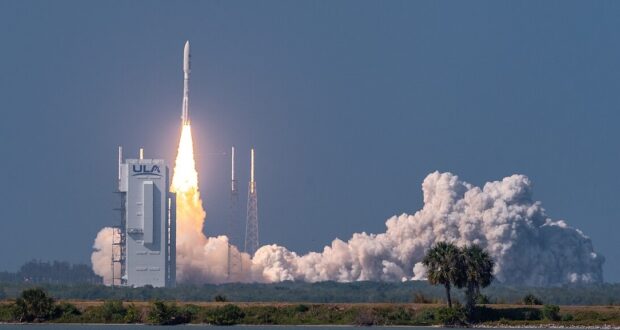
Image: An Atlas V conducts the first U.S. Space Force space launch (26 March 2020) (Source: U.S. Air Force/Joshua Conti/Public Domain)



.jpg)