 Human Security Centre Human Rights and International Security Research
By Sam Biden, Junior Fellow
2 December, 2025
The international community has long sought to regulate weapons of mass destruction (WMDs), – weapons with high lethality and destructive potential – in global conflicts. Typically, these weapons are not only prohibited outright with no exceptions, but their development and stockpiling remain heavily restricted. WMDs can be split into multiple categories based on how they are formulated, most notably those based on nuclear fission (atomic), nuclear fusion and fission (hydrogen/thermonuclear), biological weapons, and chemical weapons. The use of biological weapons was banned in 1972 under the Biological Weapons Convention (BWC), with above-ground testing for both forms of nuclear weapons being prohibited in 1963 with the Partial Nuclear Test Ban Treaty (PNTBT), later having their use in combat prohibited in the Treaty on the Prohibition of Nuclear Weapons (TPNW) in 2017 – although the latter treaty is far from universally subscribed to.
In between protections against biological and nuclear weapons came the same protections against chemical weapons. These weapons are based on chemical agents and are split into four categories, choking, blister, blood and nerve agents and are harmful and potentially fatal to humans when exposed. In 1993, the production, stockpiling and use of Category 1 agents (such as nerve and blister agents) and Category 2 precursors (such as chlorine and sulfur-based compounds) were officially prohibited at by the Chemical Weapons Convention (CWC), with 193 signatories of 2025. The use of chemical weapons is banned under the 1925 Geneva Convention – a policy that is also a provision of the CWC. In the modern era, their use in warfare has remained restricted with very few examples of their deployment in combat. A worrying trend in the past decade has been their increased use in Sudan and Syria, occurring on at least 5 occasions from 2016 till present. This article highlights this use alongside other alleged sporadic deployment in Ukraine and the development of chemical WMDs through the reign of Muammar Gaddafi in Libya.
Darfur & al-Jaili
Since the early 2000s, Sudan has remained the target of recurring allegations surrounding the use of chemical agents. Recent reporting indicates that Sudan’s armed forces may once again be resorting to prohibited means of warfare nearly a decade after being accused prior.
The country has previously faced serious allegations regarding their use during the military campaign in Darfur since 2016. The campaign, now spanning more than two decades, has been defined by deliberate and often brutal assaults against civilian populations. In 2016, Amnesty International documented what appeared to be repeated chemical weapons attacks carried out by Sudanese governmental forces, during offensives in Jebel Marra between January and September of that year. Restricted access to the region prevented physical sample collection, however, investigators conducted extensive interviews with fifty-seven individuals. Civilians and members of the Sudan People’s Liberation Army (SPLA) were interviewed to gather testimonial evidence, being further supported by chemical weapons specialists who concluded that the on-site evidence strongly suggested the use of blister-agents, such as mustard gas, a type of chemical weapon that causes severe burns and blistering.
Survivors described exposure to what they referred to as “poisonous smoke”, delivered by both aerially deployed bombs and ground-fired rockets. Witnesses repeatedly observed smoke clouds that shifted colour, from black to grey/white or at times transitioning through hues of blue, purple, red, green and yellow before dissipating into a residue that stuck to surrounding objects, with the smell consistently described as resembling sulphur or chlorine. The symptoms documented were severe and wide-ranging with bloody diarrhea and vomiting beginning within minutes of exposure, widespread blistering, necrosis, respiratory failure, blindness and deaths by suffocation. Caregivers told Amnesty International that children were disproportionately affected and, in several instances, entire family groups died before any medical assistance could be sought. An estimated 200-250 deaths may have resulted from these chemical exposures, though the true figure is likely higher due to insufficient medical resources.
Chemical warfare specialists reviewing the evidence found it consistent with exposure to vesicant agents such as sulphur mustard, lewisite or nitrogen mustard, all compounds prohibited by international law. They also noted that biological toxins such as trichothecene mycotoxins, a fungus-based toxin, alongside arsenic-based compounds could not be excluded without environmental or biological sampling in more detail. Without this additional physical evidence, definitive attribution of the exact compounds deployed, including their delivery method, remains medically inconclusive, yet the consistency and scale of reported symptoms present a compelling pattern of chemical exposure regardless.
After almost a decade since Darfur, in January 2025, the US government sanctioned the head of the Sudanese Armed Forces (SAF), General Abdel Fattah al-Burhan, alleging the use of chemical weapons. At the time, the United States provided no public evidence to support the accusation, leaving the claim unverified. However, a recent investigation by the French broadcaster, France 24, brought new evidence to light, marking the first public effort to substantiate these claims. Digital evidence analyzed by France 24 appears to show a yellow-green gas cloud, a visual signature consistent with chlorine release, being deployed on two occasions in September 2024. The video still circulated on a pro-Rapid Support Forces (RSF) social media account in May 2025 and was geolocated to the Barri military base near the capital, Khartoum. Alongside the visual material, investigators collected additional footage which depicts industrial chlorine canisters, a compound identified in 2016, situated near small impact craters at Garri military base and the adjacent Jaili oil refinery, both under RSF control at the time. While on-site physical and medical evidence is required to independently verify the use of the compounds with the intent to harm civilians, the remnants of chemical weapon containers, including chlorine, reinforcing concerns.
Based on reporting, Sudan represents the primary regional actor with chemical weapons, given the rarity of their creation and use across Africa, with Libya remaining the other key nation that the international community feared would use chemical weapons.
Libya
From the mid-1980s to the early 2000s, Libya under Muammar Gaddafi pursued a chemical weapons program that drew increasing international attention. The regime developed a network of three major facilities, each designed to support production, storage or deployment of chemical agents. The first, Pharma-150, was ostensibly a pharmaceuticals plant and by the late 1980s, analysts estimated the facility could produce upwards of 100 metric tons of blister and nerve agents within a three-year period. Libya expanded its network with Pharma-200 at the Sabha military base and Pharma-300 (Rabta II) near Tarhuna. Despite participating in negotiations, Libya declined to sign the treaty in 1993, citing regional security concerns, particularly Israel’s alleged nuclear arsenal.
By October, the Libyan government agreed to inspections of laboratories and military sites. On 19 December 2003, Gaddafi publicly committed to dismantling Libya’s WMD programs and pledged adherence to the CWC. A partial declaration submitted to the OPCW on 20 February 2004 included 3,500 aerial chemical munitions and approximately 23 metric tons of sulfur mustard alongside roughly 1,300 metric tons of sarin precursors. Despite public cooperation with the OPCW, the pace of destruction lagged. In 2005, Libya was granted an extension until December 2011 to complete dismantlement, however, by the outbreak of the 2011 uprising, an estimated 6.5–9.5 metric tons of sulfur mustard and 800 metric tons of precursor chemicals remained undeclared or undestroyed.
Following the fall of Gaddafi, Libya’s transitional authorities reaffirmed their commitment to the CWC and submitted plans to destroy all remaining chemical stockpiles by December 2016. By February 2014, Libya declared all usable chemical weapons destroyed, with OPCW verification in May confirming the elimination of Category 1 agents and the destruction of Category 2 precursors, continuing past 2016. By 2018, the OPCW successfully announced the destruction of all Category 2 precursors.
Beyond Africa
While the use of chemical weapons remains a small yet troubling concern in Africa, the use of these weapons in recent years, particularly in Syria and Ukraine, points to a worrying trend over the lack of discretion when selecting appropriate means of conducting warfare. As regards Syria, beyond the widely analysed attack in Ghouta in 2013 that killed over 700 people, there have been two major (and many minor) instances of chemical weapon use.
In 2017, the OPCW Fact-Finding Mission (FFM) launched an investigation into a chemical weapons attack in Khan Shaykhun. Investigators were initially unable to secure or access the site and therefore were entirely dependent on testimony via interviews with witnesses and medical personnel, biomedical samples brought off site and physical samples brought forward by individuals present at the time of the incident. Although this evidence collection process lacked ideal forensic control, the consistency across multiple streams of information strengthened the reliability of the findings. Autopsy documentation and biomedical analysis confirmed that three individuals who were transported from Syria to a neighboring country shortly after the attack died from exposure to sarin or a chemically related nerve agent, with additional biomedical specimens taken from other surviving casualties also testing positive for sarin exposure. A separate group of samples submitted by the Idlib Health Directorate confirmed additional results, with at least one match between an anonymous sample and a directly interviewed casualty. Finally, another final batch of samples provided by the Syrian American Medical Society yielded four additional confirmed exposures, totaling 11 instances. In total, the collected data indicated approximately 100 deaths with at least 200 additional casualties, with medical personnel being among the injured due to secondary sarin exposure. With the growing biological evidence of sarin being present, the absence of traumatic physical injury among victims, combined with a spike in simultaneous respiratory and neurological symptoms, only further supported the conclusion that a toxic chemical was dispersed into the environment rather than weaponized through conventional explosives.
In 2018, the OPCW concluded that there are reasonable grounds to believe the SAF conducted a chemical attack in Douma on April 7, during an offensive aimed at regaining control of the city. According to the findings, at least one Mi-8/17 helicopter operating under the command of the Tiger Forces departed Dumayr airbase and dropped two yellow gas cylinders over a densely populated residential area, striking the roof of a three story building below. Upon impact, the cylinder exploded and released chlorine gas rapidly throughout the building, killing 43 civilians. The second cylinder impacted on the neighbouring roof, which was fortunately empty at the time and did not result in any deaths.
The 2024 fall of former Syria president Bashar al-Assad caused renewed concerns over the destruction and potential future use of Syria’s remaining chemical weapons, 12 years after they had vowed to destroy them upon joining the CWC in 2013. Firstly, strikes on military compounds that contained chemical weapons occurred in the days following Assad’s ousting, causing the OPCW to theorize that contamination could be a very real issue if the weapons were hit directly, causing spillover into the contested coastal areas. Alongside this, the destruction of these sites may impact investigations the OPCW needed to do to ensure Syria’s previous compliance with the CWC, such as their commitments to destroying Category 1 agents and Category 2 precursors. Second and most worryingly, the OPCW identified the use of chemical weapons by non-state actors between 2013-2024 yet could not accurately identify the groups responsible. Given the now continuing conflict between these armed groups, such as leading group Hayat Tahrir al-Sham (HTS) and opposing forces such as the Syrian Popular Resistance and Military Council for the Liberation of Syria, the use of chemical weapons poses a greater risk. This risk is only exacerbated by the allowance of Assad’s regime to use chemical weapons initially. In short, enforcing against the new transitional government could prove extremely difficult, they may know little of Syria’s chemical weapons program, how they were developed, stored or deployed, potentially leading to an over-invasive and provocative investigation by the OPCW.
Over in Europe on February 14 of this year, over two years of evidence had slowly piled up against the Russian forces, resulting in Ukraine’s Ministry of Foreign Affairs formally accusing the Russian Federation of violating the CWC. Between February 2023 and February 2025, Ukrainian authorities documented 6,129 incidents involving Russian munitions containing hazardous chemicals. The allegation follows the release of the Second OPCW Technical Assistance Visit Report, in which specialists assessed materials submitted by Ukraine and evaluated whether documented incidents meet the legal threshold for prohibited chemical weapons use. According to the Ukrainian Foreign Ministry, OPCW specialists examined multiple forms of evidence, including four captured Russian RG-Vo-type gas grenades, alongside soil and vegetation samples collected from attack sites. Two independently accredited laboratories verified the presence of banned substances, including 2-Chlorobenzalmalononitrile (CS) and chloroacetophenone (CN), both riot control agents.
Conclusion
Despite the CWC offering the same degree of prohibition and protection as the TNPT, BWC and PNTBT, the degree of selective enforcement has allowed states to operate seemingly beyond regulations. Sudan, despite facing diplomatic sanctions for their use of chemical weapons, has not been meaningfully enforced against in traditional means, such as through the International Criminal Court. It appears that any fruitful investigation into violations of the CWC either do not fully begin or is treated as mere social condemnation, rather than legislative reinforcement. This sets a worrying trend for the enforcement of other WMD protections, especially as the looming threat of the use of the next nuclear weapon appears more probable every day with Putin repeatedly signaling he will use extreme force in the Ukraine war. If this pattern continues, the consequences extend far beyond the individual conflicts where chemical agents have been used. Their use could become less shocking, less politically costly and more readily justified with a new norm to take hold, one where the use of other forms of WMDs becomes tolerated through inaction rather than outlawed through principle.
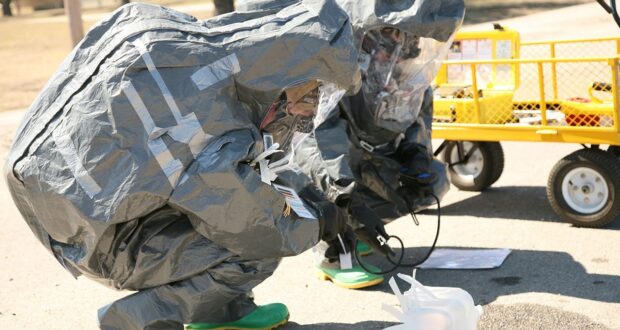
Image: A US chemical warfare exercise