 Human Security Centre Human Rights and International Security Research
By Dr Rowan Allport, Deputy Director
12 January, 2026
On 29 December 2025, China announced plans to conduct the ‘Justice Mission 2025’ exercise around Taiwan, with the operation commencing the following day and concluding on 31 December. Such exercises seek to develop the People’s Liberation Army’s (PLA) military capabilities and test its readiness to execute contingency plans. The People’s Republic of China (PRC) has a well-developed set of war plans for use against Taiwan and, if necessary, its U.S.-led partners in order to force the Republic of China (ROC) to surrender to Beijing’s will. Justice Mission 2025 and other recent exercises have chiefly sought to rehearse what in People’s Liberation Army (PLA) parlance is a Joint Blockade Campaign and a Joint Firepower Strike Campaign against Taiwan. Taipei reacted by raising its state of alert, and in the event of conflict – potentially scaling up to a full invasion – its own defensive contingencies would be activated.
However, as my book, War Plan Taiwan: OPLAN 5077 and the U.S. Struggle for the Pacific outlines, U.S. support to the ROC would be critical to the island’s survival as an independent political entity. The U.S. has long had contingency plans in place for defending the ROC from the PRC, with the early 21st century seeing these plans begin to be reimagined as China’s power grew. It is this external support of the ROC that Beijing’s rhetoric surrounding this latest exercise has sought to target. The ongoing dispute between Beijing and Tokyo after the Japanese Prime Minister remarked that a Chinese attack on Taiwan could threaten Japan’s survival and necessitate a response also serves to underline the importance of the island’s fate to Japan both nationally and as the base of much of the U.S. military in the Western Pacific.
Justice Mission 2025 marks the latest in a series of exercises that began with the August 2022 war games around Taiwan in response to U.S. House Speaker Nancy Pelosi’s visit to the island. This was followed up with the Joint Sword exercise of April 2023, which was succeeded by Joint Sword 2024A (May 2024), Joint Sword 2024B (October 2024), an unnamed naval exercise (December 2024) and Strait Thunder 2025A (April 2025), all of which focused on rehearsing operations to blockade the ROC, with the 2023 and both 2025 drills adding simulated precision strikes on targets in and around Taiwan to the mix. Justice Mission 2025 also featured live rocket firings to the north and south of the main island, with munitions landing closer to the main island than ever before. The China-declared exercise zones also surrounded Taiwan to a more comprehensive extent than any previous such event.
While the Joint Sword and Strait Thunder exercises were framed by the PRC as retaliation for some type of transgression by the ROC leadership, Justice Mission 2025 was portrayed as a response – albeit likely disingenuously given the time needed to plan such an operation – to the recent authorization of a series of arms sales to Taiwan by the U.S., and implicitly as spurred by the ongoing spat with Japan. Combat readiness patrols and blockade drills aimed at the ROC led events. However, preventing outside intervention in a PRC attempt to exert control over Taiwan, framed by the PLA as “all-dimensional deterrence outside island chain” (i.e., a show of force to dissuade the U.S. and allies beyond Taiwan) was also a central narrative focus of the exercise. A spokesperson for the PLA’s Eastern Theater Command – the regional headquarters that would lead any operation against the ROC – stated that the exercise was intended as “a stern warning against ‘Taiwan independence’ separatist forces and external interference forces.” The Defense Ministry warned the ROC’s partners that they should “abandon illusions of using Taiwan to contain China.” The PLA has a well-developed concept of counter-intervention to prevent outside interference in an attempt to subdue the ROC.
As War Plan Taiwan explains, the Pentagon sees two central challenges in wartime: keeping in-theater U.S. forces operational, and bringing in reinforcements. The PLA’s anti-access strategy, which aims to thwart both by barring U.S. reinforcements from entering the theater and suppressing those already forward-deployed – an approach referred to as anti-access and area denial in U.S. military parlance – has for decades been the presumed central challenge to the U.S. The December 2025 U.S. National Security Strategy stated aim of “reinforcing U.S. and allies’ capacity to deny any attempt to seize Taiwan or achieve a balance of forces so unfavorable to us as to make defending that island impossible,” means that this operational imperative remains central.
That the PRC’s propaganda is now pivoting towards deterring China’s partners is no surprise, as the PLA has long recognized the ability to deter or defeat U.S. intervention attempts as central to any military effort to take Taiwan. The fielding of advanced submarines, bombers, and a supporting network of sensors, analytical, and command and control systems now allows Beijing to reach targets thousands of miles beyond its territory. The development of anti-ship ballistic missiles has most prominently caught the popular imagination. Alarmingly, the 2025 edition of the DoD’s Military and Security Developments Involving the People’s Republic of China annual report to Congress highlights the fielding of the DF-27 as a conventional ICBM with an ASBM variant and an estimated 5,000–8,000 km range capable of reaching the U.S. West Coast, endangering U.S. forces and supporting civilian assets and home across their entire wartime transit route.
The announcement of Justice Mission 2025 was accompanied by the publication of several propaganda graphics. One shows a pair of hands reaching out to Taiwan in the colors of the U.S. flag with the weapons systems recently authorized for sale to the ROC superimposed on them, being severed by a sword. Another is illustrated by two shields covered in imagery of the Great Wall of China to the east of Taiwan, forcing U.S. assets, including C-130 transport aircraft, Virginia-class submarines, and a merchant ship delivering U.S.-built HIMARS rocket launcher systems to the ROC to turn back (a Chinese Coast Guard poster has this merchant ship being forcibly boarded). An additional graphic shows arrows from mainland China striking ROC targets in and around Taiwan – including green maggots representing the country’s DPP leadership – while a U.S. Navy destroyer turns away from the island.
Yet the latest exercise can also be seen as a demonstration of the PLA’s shortfalls when it comes to Taiwan. Beyond the blockade, strike, and counter-intervention operations is the most extreme conventional option: a Joint Island Landing Campaign to invade the territory. While Beijing would no doubt prefer to avoid this, attempts to quarantine the ROC would not offer a short-term solution, and U.S. experience in Iraq and Russia’s efforts in Ukraine suggest the leadership decapitation strikes the PRC reportedly favors executing against the ROC carry a high risk of failing to deliver the desired results.
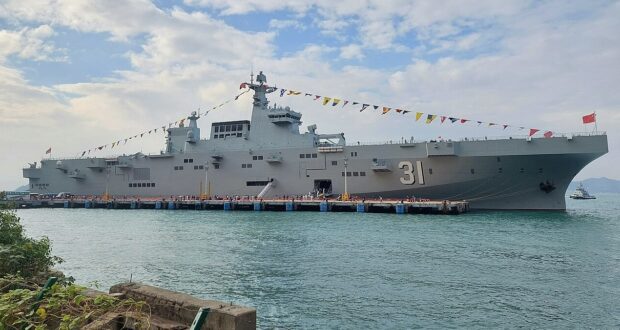
The exercise can thus be interpreted as China making the best of what it has available, amidst a realization that the keystone capability is missing. The token appearance of a small group of amphibious assault ships and some drills to raid or seize key sites such as ports in eastern Taiwan does nothing to detract from the widely-held assessment that the PRC currently falls short of the lift and enabling capabilities required to be confident of a successful invasion at short notice. Although a blockade and strikes could be carried out with little warning, an invasion would take weeks (and likely months) of visible preparation, due to the need to mobilise civilian shipping and other assets. While the cognitive warfare surrounding the exercise has sought to instill a feeling of hopeless vulnerability amongst Taiwan’s population, the reality serves to highlight PLA shortcomings.
None of this should be a cause for complacency. The PRC’s apparent desire to have the capability to stage a successful invasion in 2027 may or may not be realistic, but it serves as a benchmark for U.S. preparations for conflict. A major goal of these exercises is normalization: the presence of a force capable of blockading the island is only an exercise until it is not. In his New Year address, President Xi stated that “The reunification of our motherland, a trend of the times, is unstoppable.” The U.S. condemnation of the exercise did eventually arrive, but was relatively muted – likely because President Trump sought to preserve a positive atmosphere ahead of trade talks with Beijing. Ultimately, this exercise is part of a long game by Beijing that will take years to play out.
Image: a Type -75 landing helicopter dock, an example of which participated in Justice Mission 2025 (cropped) (Source: 建園春秋 via CC BY-SA 4.0)