 Human Security Centre Human Rights and International Security Research
By Dr Rowan Allport, Deputy Director
1 April, 2026
Even when the United States and its allies appear to win on the battlefield, modern wars are proving far harder to conclude. One of the first questions military planners must answer is how a war will end. The most extreme variant of war termination was embodied in the unconditional surrender of the leading Axis powers during World War II. However, outcomes that see an opponent’s state fully taken under the victor’s control are rare. Far more common are conflicts fought to secure limited objectives that end with diplomatic settlements. But in a modern environment, even wars with constrained ambitions are increasingly challenging to end. The ongoing conflict in Iran is a reminder that modern interstate wars increasingly continue long after the supposedly decisive battle is over.
The war between the United States and Israel on the one hand and Iran on the other (with many parties caught in between) has confused goals, but ending Iran’s ballistic missile production capability and nuclear program are those most frequently referenced. Through these efforts, Washington claims that it is preventing Tehran from creating a shield of conventionally-armed, precision-guided missiles as a deterrent against action to stop Iran from developing a nuclear weapon.
Given the limitations of Iran’s air defence network, allied firepower and the relative fragility of the industrial supply chains required to support these efforts, denying Tehran these objectives – at least in the short term – should be straightforward given sufficient bombing sorties. Indeed, while questions remain over how to address Iran’s enriched uranium, the immediate military task may already have been largely accomplished alongside the destruction of most of Iran’s wider air and naval power. Yet following Tehran’s decision to take the offensive against local shipping using drones, mines and other short-range systems, the conflict has now metamorphosed into a battle to reopen the Strait of Hormuz – a waterway critical to the global economy.
Claims that the U.S. did not plan for such Iranian action confuse military planning with the assumptions of the political leadership: U.S. Central Command contingency plans to counter a Hormuz closure have been in place for decades, and the failure here lies in the White House. In this light, it is easy to mock the simultaneous claim of President Trump that the U.S. has destroyed “100% of Iran’s military capability” while also stating that Tehran could “send a drone or two, drop a mine, or deliver a close-range missile somewhere along, or in, this waterway.” Yet in focusing on the obvious failures of the administration, we are at risk of missing that these statements accurately hit upon the increasing problem of the capacity of states to keep fighting at what is to them an acceptable cost – particularly when they regard the stakes as existential.
What has emerged in the Gulf is an increasingly familiar pattern of modern war. With Iran having, for the moment, largely lost its ability to pursue its nuclear and missile programs, the U.S. and Israel have successfully employed a strategy of denial by preventing Iran from achieving its goals. Yet denial has not ended the war. Iran retains the ability to implement a different strategy entirely – one centered on cost imposition rather than direct victory. Faced with what the regime in Tehran regards as an existential war of survival, it has limited incentive to yield in a manner favourable to the U.S.
The Gulf conflict illustrates a broader pattern that has emerged across several contemporary wars. Russia’s war in Ukraine demonstrates how an adversary denied its initial objectives can continue to wage war through missile strikes and drone attacks against infrastructure. The Houthi campaign in the Red Sea has shown how relatively inexpensive weapons can disrupt a major maritime corridor despite the failure of their opening attacks on Israel to influence Tel Aviv’s actions in Gaza. Across these conflicts, the pattern is the same: states and state-like actors increasingly possess the ability to continue fighting through dispersed, resilient and relatively cheap capabilities, including drones, rockets, shorter-range missiles and mines long after they have failed to achieve their original objective.
Should it opt for the use of force, China has multiple options: some combination of blockade and bombardment would represent a conservative path, but would invite a protracted conflict. Invasion would be high-risk, but potentially allow Beijing to avoid a multi-year campaign that less extreme measures could entail. As I outline in War Plan Taiwan: OPLAN 5077 and the U.S. Struggle for the Pacific, the U.S. has long planned for a conflict with Beijing over the territory, and success in such a scenario is now widely considered to be the most challenging non-nuclear contingency the U.S. military faces.
Yet the invasion option also plays to the strengths of the U.S. and its allies and partners, necessitating as it does the transit of the PLA invasion force across the open sea in vulnerable sea and air platforms. Much of the current Western operational thinking about Taiwan rests on deterrence by denial through the threat of interdicting this armada with the aims of convincing Beijing that an invasion would fail. Both the 2025 National Security Strategy (NSS) and the 2026 National Defense Strategies (NDS) reference the concept, with the former outright stating that an intent to “build a military capable of denying aggression anywhere in the First Island Chain.” Some war games have suggested that a Chinese attempt to seize the island would likely be repelled, albeit at a high cost to the defenders.
Left largely unanswered, however, is the matter of what comes next. The catastrophic casualties that are implicit in a failed invasion would likely motivate Beijing to double down rather than give up, given the risk defeat would pose to the sustainability of the regime. Even if it proved possible for allied forces to build on the defeat of the invasion through a major effort to attrit the PLA’s naval and air power, systems including short-range ballistic missiles and drones would remain operational and well within range of Taiwan and the adjacent waters. This would render life on the island beyond perhaps basic survival very difficult, leave vast tracks of the sea lanes vital to the global economy unusable, and commit the allies to an indefinite war of endurance.
Importantly, the Chinese systems required for this outcome would be sheltered under a dense ground-based air and missile defence system covering the mainland. The relative success of the U.S. and Israel in striking mobile launchers and their supporting infrastructure in Iran has been enabled through broad suppression of enemy air defenses and the consequent ability of non-stealth platforms such as the RMQ-9 Reaper drone to remain on constant patrol (although not without losses), but even this is unlikely to be sufficient to suppress the capabilities required to close the Strait of Hormuz. Circumstances in a Taiwan contingency would be far less favourable, with PLA forces afforded a sanctuary within the world’s densest and most advanced air and missile defence system.
Attempting to counter platforms based on the mainland would commit the U.S. to a suppression campaign on a scale not seen since the World War II efforts to counter V-1 cruise and V-2 ballistic missile launches in Europe and similar efforts to counter kamikaze aircraft strikes at source in the Pacific. Worse, both of those efforts ultimately required either the use or credible threat of ground forces for final success. If an attempt to seize mainland Iranian territory to end efforts to interdict Hormuz is a political non-starter, it is at least physically possible: no such chance would exist regarding mainland China.
The possibility of conflicts arising from this route is, of course, recognised, with the U.S. itself adopting an approach of deterrence through punishment and cost imposition. In Iran, that could manifest as striking the state’s national infrastructure should passage through the Strait of Hormuz not be restored. Both Israel and Ukraine have attempted something similar against their Houthi and Russian opponents. In addition to denial, the Biden-era 2022 NDS listed cost imposition as part of its deterrence strategy, with imposition potential being direct in the form of measures such as conventional strikes and economic sanctions, as well as collective action in concert with allies and partners. The 2026 NDS is less clear in this area, but measures such as enhancing the defence industrial base are designed to ensure that sustained pressure can be maintained on opponents beyond the denial phase.
Yet even this approach offers no guarantees. There will doubtless be elements of the regime in Tehran that would see their country reduced to a pre-industrial state if it allowed them to remain in power and shape the conditions to deter further attacks. China’s size and industrial depth would make meaningful degradation through conventional strikes extremely difficult. A counter-blockade of the PRC (People’s Republic of China) would prove painful, but as a mainland Asian state, the country is impossible to isolate to a survival-endangering level.
With respect to China, this is not the first time that the U.S. has faced the issue of war termination with a great power. War Plan Orange, the conceptual plan for conflict between the US and Japan developed between the World Wars, envisaged the final phase of the war as an effort to compel Tokyo to surrender through bombardment and blockade – a scenario which eventually played out. Early Cold War plans envisaged massive nuclear strikes on the USSR, followed by large-scale conventional offensives into Soviet-controlled territory, designed to defeat Soviet forces and compel capitulation. The U.S. loss of the nuclear monopoly led to the allies developing the laddered Flexible Response approach designed to allow for a diplomatic path to favourable war termination without an all-out nuclear exchange. Importantly, the need to ensure the Communist Party in Moscow that its hold on power would not be endangered in the event of hostilities ending was recognised, with the 1980s Maritime Strategy – the U.S. Navy’s concept for conventional warfighting with the USSR – presenting the following vision:
At the end of the conflict, from the Soviets’ perspective, the operations envisioned by the Maritime Strategy would defeat their strategy and amputate their global reach by neutralizing or destroying their fleet. The Communist Party would remain in control of the Soviet Union, and the homeland would be intact, although it would now be threatened.
The issue of the future of the governing regime is critical, whether the focus is on denial or cost imposition in an environment where both parties possess nuclear weapons, or directly imposed regime change is impossible. The central lesson from these historical examples is that war termination depends not only on defeating an adversary’s military strategy, but also on shaping the political conditions under which that adversary can accept defeat. Strategies that threaten the outright destruction of a leadership risk removing any incentive for that regime to end the conflict.
The war in the Gulf illustrates how this dilemma plays out in practice. Iran has largely been denied the ability to achieve its core objectives, yet it retains sufficient means to impose costs by disrupting maritime trade. As long as Tehran believes that continued disruption offers leverage – or that defeat would threaten the regime’s survival – the conflict can continue indefinitely at a level it finds tolerable.
The implications for Taiwan are sobering. A strategy of denial may well succeed in preventing China from conquering the island. Yet if Beijing retains the ability to bombard Taiwan or disrupt the sea lanes on which East Asia depends, the result could be a prolonged war of endurance rather than a decisive victory. Without a credible pathway to war termination – one that both denies China its objectives while leaving space for the regime to survive – military success may simply mark the beginning of a much longer conflict.
Winning, in other words, may not be enough.
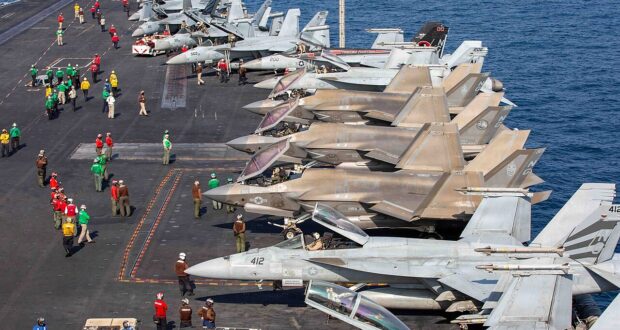
Image: Aircraft attached to Carrier Air Wing (CVW) 9 sit on the flight deck of Nimitz-class aircraft carrier USS Abraham Lincoln (CVN 72) in support of Operation Epic Fury (Public Domain)